
Home » News » How to Choose the Right Feed Pellet Machine for Your Poultry Farm in 2026
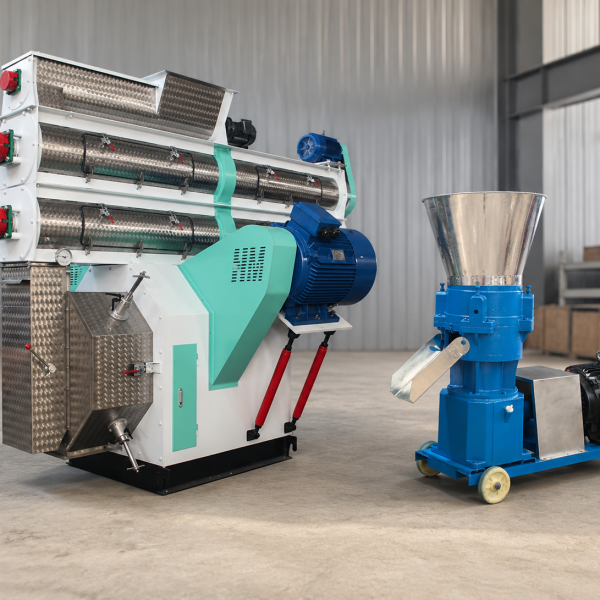
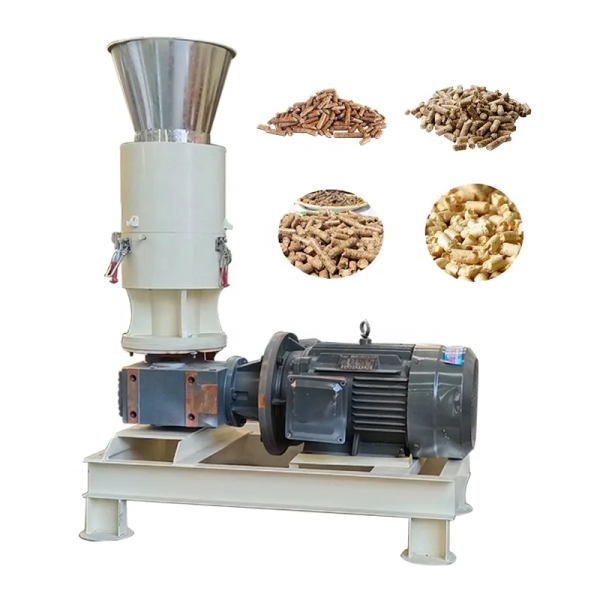
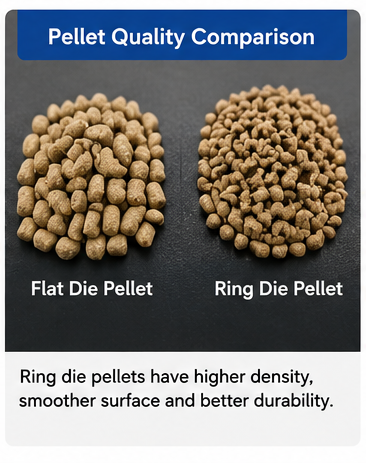
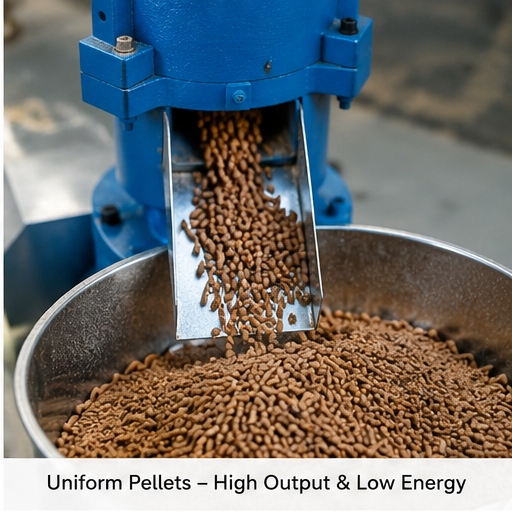
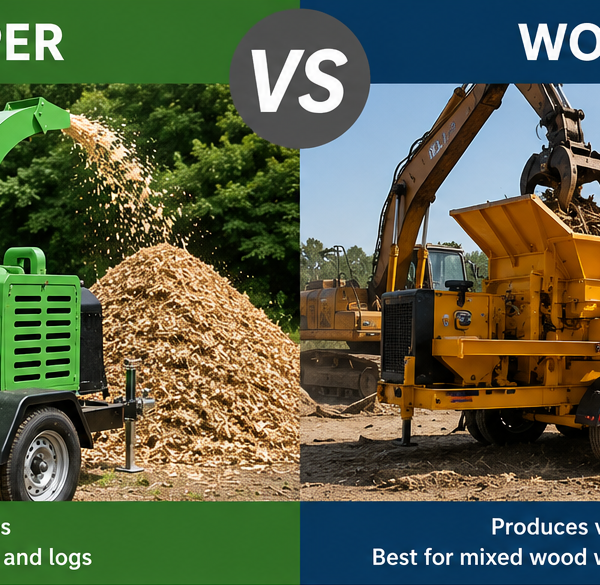
Flat Die vs Ring Die
For poultry farms, feed cost is never a small issue. Broiler farms, layer farms, duck farms, goose farms, and breeding cooperatives all need stable feed supply. When feed prices change, transportation becomes expensive, or finished feed quality is not consistent, many farmers start thinking about producing their own feed pellets.
This is where a feed pellet machine becomes useful.
But choosing the right machine is not just about asking for the lowest price. A flat die pellet machine and a ring die pellet machine can both press feed powder into pellets, but they are designed for different production scales and working conditions.
For a small poultry farm, a flat die machine may be enough. For commercial feed production or long-time continuous operation, a ring die pellet machine is usually more suitable.
Why Poultry Farms Produce Their Own Pellet Feed
Poultry feed quality affects daily feeding results. Pellet size, feed uniformity, dust rate, hardness, and raw material stability can all influence feed intake. For broiler farms, stable feed supports growth management. For layer farms, pellet or crumble feed can help reduce selective feeding and waste.
Producing feed on-site also gives farmers more control. They can use local raw materials such as corn, soybean meal, bran, premix, fish meal, oil cake, and other agricultural ingredients. This is useful in markets where finished feed is expensive or supply is not stable.
However, a feed pellet machine does not work alone. Pellet quality is also affected by grinding size, mixing uniformity, moisture level, die compression ratio, cooling, and screening. If raw materials are not properly prepared, even a good pellet mill may produce loose or dusty pellets.
Flat Die vs Ring Die Feed Pellet Machine: Key Difference
A flat die feed pellet machine uses a horizontal flat die. The roller presses mixed feed material through the die holes to form pellets. This structure is simple, compact, and easy to operate.
A ring die feed pellet machine uses a ring-shaped die. The material enters the pelleting chamber and is pressed between the roller and the inner surface of the ring die. This design is more suitable for continuous operation and higher capacity.
In simple terms, flat die machines are suitable for small-scale, flexible, low-cost production. Ring die machines are more suitable for higher output, better pellet consistency, and complete feed production lines.
This does not mean ring die is always better. If your daily feed demand is small, a large ring die system may create unnecessary power, labor, and maintenance pressure. If your daily output requirement is high, a flat die machine may not be able to keep up.
When Should You Choose a Flat Die Pellet Machine?
A flat die feed pellet machine is suitable for small poultry farms, family farms, rural feed processing points, trial feed production, and buyers with limited budgets.
If you mainly produce feed for your own chickens, ducks, or geese, and the daily production time is not long, a flat die pellet machine can be a practical choice. It has lower investment cost, smaller footprint, simple operation, and relatively easy maintenance.
For farms that are new to pellet feed production, flat die machines also reduce the initial risk. You can test raw material formulas, pellet diameter, and feeding results before deciding whether to upgrade to a larger ring die production line.
The limitation is clear. Flat die machines are not ideal for long-time continuous production. The output is lower, and pellet quality may fluctuate more easily when raw material moisture or formula changes.
So, flat die machines are more suitable for self-use feed production, not large commercial feed sales.
When Is a Ring Die Pellet Machine a Better Choice?
A ring die feed pellet machine is more suitable for medium and large poultry farms, feed processing plants, cooperatives, dealers, and commercial feed production projects.
Its main advantages are higher capacity, stronger continuous operation, and more stable pellet quality. If you need to produce feed for several farms or sell feed pellets to local customers, a ring die machine is usually a better long-term option.
Ring die machines also work better with a complete poultry feed production line. A typical line may include a hammer mill, mixer, elevator, ring die pellet mill, cooler, screener, packing machine, and control cabinet. For customers who want to reduce labor, improve efficiency, and maintain consistent pellet quality, this setup makes more sense.
Of course, ring die machines require higher investment. They need better power supply, more installation space, trained operators, and regular maintenance. Wearing parts such as ring dies and rollers also cost more than those of flat die machines.
Ring die is not simply the “better machine.” It is the better choice when your production scale can justify the investment.
Key Factors to Check Before Buying
Before asking for a quotation, buyers should confirm several basic details.
First, confirm the poultry type. Broilers, layers, breeders, ducks, and geese may require different pellet sizes and feeding structures. Chicks usually need smaller pellets or crumble feed, while growing and adult poultry can use larger pellets.
Second, calculate daily feed demand. If your farm only needs several hundred kilograms per day, a flat die machine may be enough. If you need several tons per day with stable production, a ring die pellet mill is more reasonable.
Third, check your raw material formula. Corn, soybean meal, bran, grass powder, oily materials, and high-fiber ingredients behave differently during pelleting. Too much oil may make pellets softer. Too much fiber may reduce output and increase die wear.
Fourth, confirm power supply. Overseas customers may have different voltage and frequency standards. Some areas have unstable three-phase electricity. Some projects may need diesel engine options.
Finally, consider supporting equipment. If you already have a grinder and mixer, you may only need a pellet mill. If not, a complete small feed production system may be more practical.
Common Buying Mistakes
The first mistake is choosing only by price. A cheap machine may look attractive, but if the motor is weak, the die material is poor, the capacity is overstated, or spare parts are difficult to get, the real cost may be higher later.
The second mistake is ignoring the whole process. A pellet mill usually needs proper grinding and mixing before pelleting. After pelleting, hot pellets should be cooled and screened before packing or storage.
The third mistake is not asking about wearing parts. Dies and rollers are core consumable parts. Buyers should ask about material, heat treatment, normal service life, replacement method, spare part price, and delivery time.
The fourth mistake is buying a machine that is too large. Larger capacity also means higher requirements for power, feeding, mixing, operation, and maintenance. If the whole system cannot support the machine, the actual output will not meet expectations.
Final Recommendation: Flat Die or Ring Die?
Choose a flat die feed pellet machine if you run a small poultry farm, produce feed mainly for self-use, have limited budget, and do not need high daily output. It is simple, affordable, and easier to maintain.
Choose a ring die feed pellet machine if you operate a medium or large poultry farm, feed processing plant, cooperative, or commercial feed project. It is better for continuous production, higher capacity, better pellet consistency, and complete poultry feed production lines.
The right machine is not always the cheapest one. It is also not always the largest one. A suitable feed pellet machine should match your farm scale, raw materials, power supply, labor skill, budget, and future expansion plan.
CTA
If you are choosing a feed pellet machine for a poultry farm, chicken feed processing project, or small feed production line, send us your poultry type, raw materials, target capacity, pellet diameter, voltage, workshop space, and budget range.
Our technical team can help you compare flat die and ring die feed pellet machines and recommend a practical configuration for your production needs.