
Home » News » Flat Die vs Ring Die Feed Pellet Machine: Which One Is Right for You?
Flat Die vs Ring Die Feed Pellet Machine: Which One Is Right for You?
Why Choosing the Right Pellet Machine Matters
Many first-time buyers believe the decision is straightforward:
Buy a pellet machine, install it, and begin producing feed.
In practice, selecting the wrong machine can lead to much higher production costs, inconsistent pellet quality, and limited room for business growth.
As a startup feed mill owner, every investment matters.
A machine that is too small may quickly become a production bottleneck.
A machine that is too large may increase capital costs without delivering meaningful returns.
The key question is not: “Which machine is better?”
The better question is: “Which machine matches my production goals?”
Understanding the differences between flat die and ring die pellet machines helps avoid expensive mistakes before purchasing.
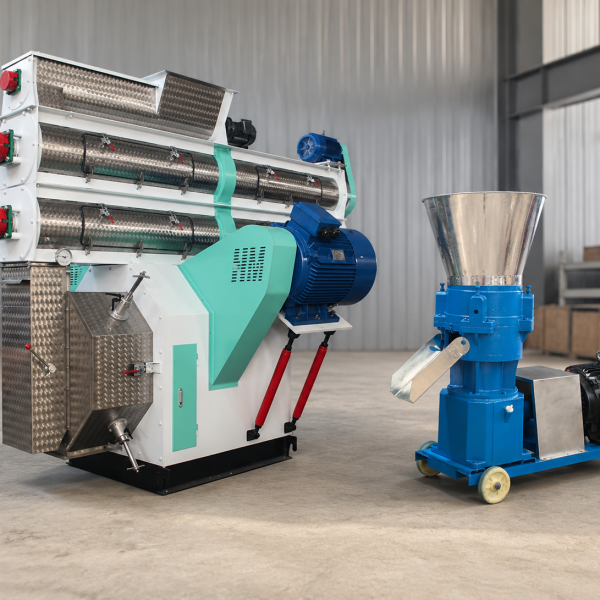
Flat Die vs Ring Die: Different Solutions for Different Businesses
Although both machines produce feed pellets, they are designed for different production scales and operating conditions.
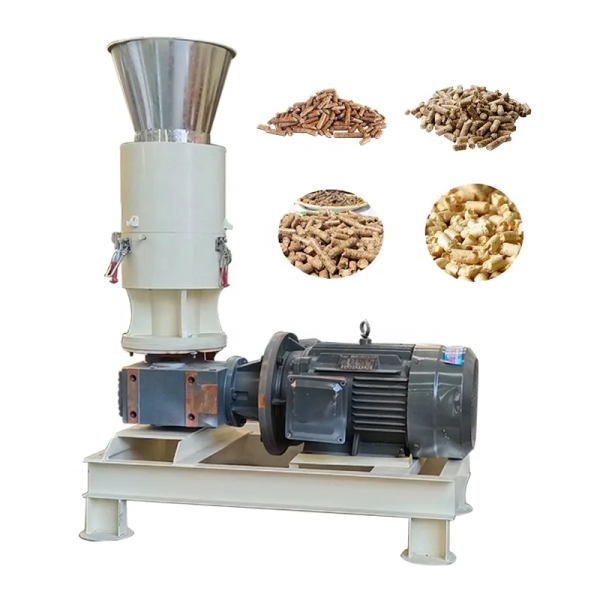
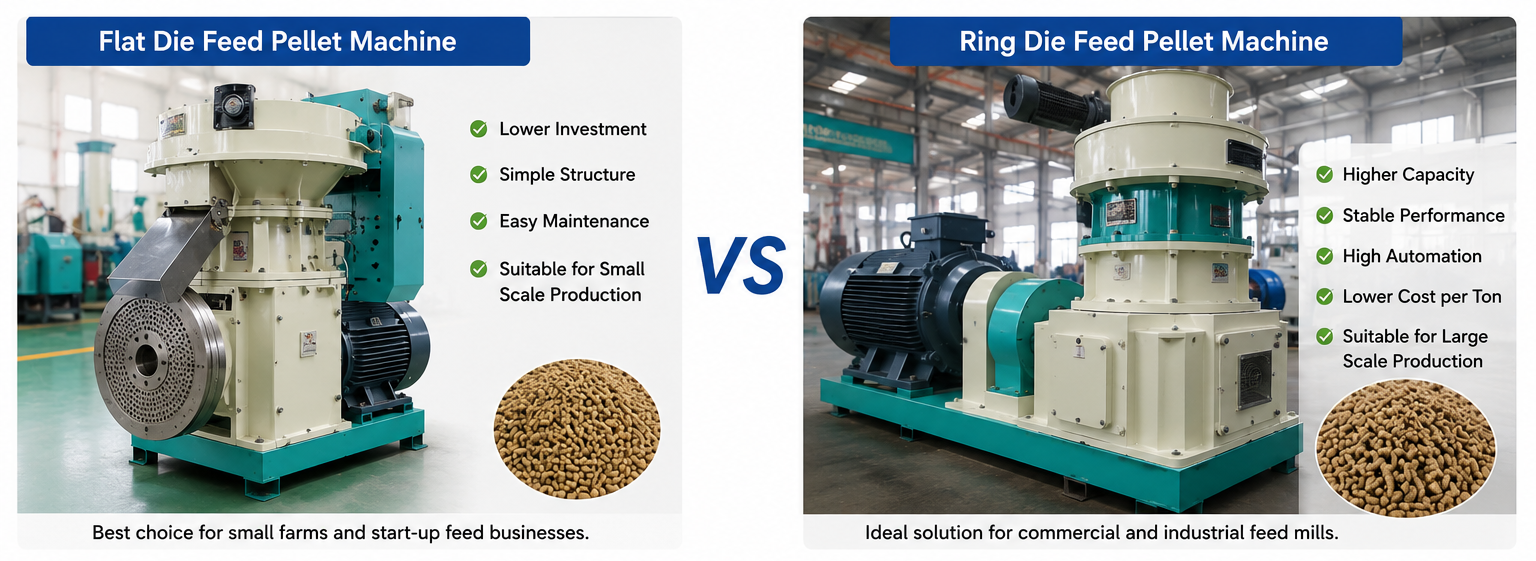
Flat Die Feed Pellet Machine
Flat die pellet machines are widely used for:
- Family farms
- Small livestock operations
- Startup feed businesses
- Small-scale feed processing
Typical advantages include:
- Lower purchase cost
- Simple structure
- Easy installation
- Convenient maintenance
- Lower investment risk
These characteristics make flat die machines attractive for businesses entering feed production for the first time.
Ring Die Feed Pellet Machine
Ring die pellet machines are commonly selected for:
- Commercial feed mills
- Integrated livestock companies
- Aquafeed plants
- Large-scale feed processing lines
Advantages include:
- Higher production capacity
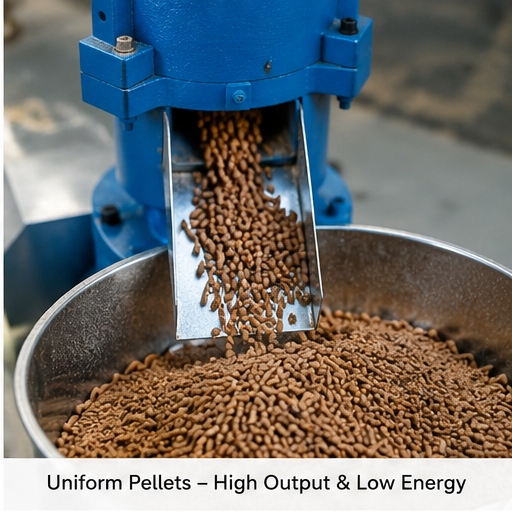
- Better pellet consistency
- Higher automation level
- Longer continuous operating time
- Greater production efficiency
For companies planning long-term expansion, ring die systems often provide stronger scalability.
Investment Cost Comparison
Initial investment is often the first concern for startup businesses.
Flat die machines generally require:
- Lower equipment investment
- Simpler auxiliary equipment
- Lower installation costs
For limited production volumes, this can be an economical choice.
Ring die pellet machines require greater investment because they often include:
- Conditioners
- Feeding systems
- Cooling equipment
- Screening systems
- Automatic control cabinets
Although the initial investment is higher, production efficiency also increases substantially.
Professional buyers evaluate equipment based on total lifecycle value rather than purchase price alone.
Production Capacity Comparison
Capacity requirements vary significantly between users.
Flat Die Pellet Machine
Typical applications:
- Small poultry farms
- Pig farms
- Goat farms
- Family-operated businesses
Suitable for lower daily production volumes and flexible batch production.
Ring Die Pellet Machine
Designed for:
- Continuous production
- Large commercial feed mills
- Multi-shift operations
- Industrial feed manufacturing
Higher output makes ring die machines suitable for businesses expecting production growth.
When selecting equipment, estimate future demand rather than current demand alone.
Pellet Quality and Feed Performance
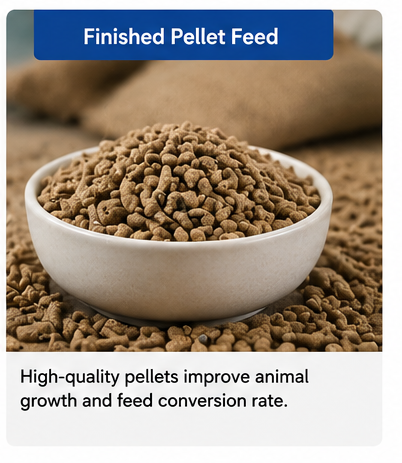
Pellet quality directly affects transportation, storage, and animal performance.
Flat Die Machine
Can produce high-quality pellets when operating with suitable formulations and moisture levels.
However, pellet consistency may vary depending on operator experience and raw material preparation.
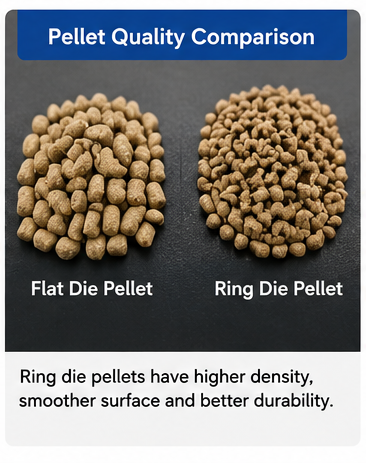
Ring Die Machine
Generally offers:
- More uniform pellet density
- Better durability
- Improved surface finish
- More stable production quality
For export feed or commercial sales, consistent pellet quality often becomes a competitive advantage.
Raw Material Compatibility
Different feed formulations require different equipment characteristics.
Flat Die Machine
Suitable for:
- Corn meal
- Soybean meal
- Wheat bran
- Grass meal
- Small-scale mixed feed
It performs well where formulations change frequently.
Ring Die Machine
Better suited for:
- Commercial livestock feed
- Poultry feed
- Aquatic feed
- High-volume compound feed
Ring die machines handle continuous production more efficiently.
Before purchasing, discuss your feed formula with the manufacturer.
Compression ratio, die configuration, and conditioning settings should match the intended raw materials.
Maintenance and Operating Costs
Operating cost includes much more than electricity.
Buyers should consider:
- Die replacement
- Roller wear
- Lubrication
- Labor
- Energy consumption
- Downtime
Flat Die Machine
Advantages:
- Easier maintenance
- Lower replacement costs
- Simpler operator training
Ideal for smaller operations with limited technical staff.
Ring Die Machine
Advantages:
- Higher production efficiency
- Longer continuous operation
- Better automation
Maintenance procedures are more complex, but higher production volumes often offset these costs.
Real Application Scenario #1: Family Poultry Farm
A family-owned poultry farm in South America produced feed for approximately 8,000 laying hens.
The owner wanted to reduce purchased feed costs without making a large capital investment.
After evaluating production requirements, a flat die pellet machine was selected.
Reasons included:
- Affordable investment
- Easy maintenance
- Flexible production batches
The farm gradually expanded production while maintaining consistent feed quality.
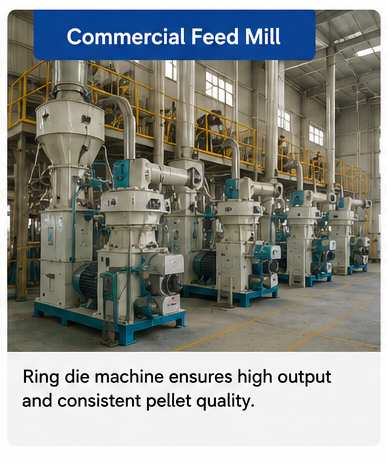
Real Application Scenario #2: Commercial Feed Mill
A commercial feed producer in Southeast Asia planned to increase production from 5 tons per hour to 12 tons per hour.
The customer required:
- Continuous operation
- Uniform pellet quality
- Automated feeding
- Reduced labor costs
Engineers recommended a ring die pellet production line equipped with conditioning, cooling, and screening systems.
Before shipment, Factory Acceptance Testing verified production capacity and pellet quality.
The equipment entered commercial production with minimal commissioning adjustments.
Product Comparison Table
| Evaluation Factor | Flat Die Machine | Ring Die Machine |
| Initial Investment | Lower | Higher |
| Production Capacity | Lower | Higher |
| Pellet Consistency | Good | Excellent |
| Continuous Operation | Moderate | Excellent |
| Automation Level | Basic | Advanced |
| Maintenance Complexity | Lower | Higher |
| Energy Efficiency | Good | Excellent |
| Suitable Business Size | Small | Medium & Large |
Common Purchasing Risks
Risk #1: Buying Based Only on Current Production
Some buyers purchase the smallest machine to reduce investment.
Within a year, production demand increases and equipment becomes insufficient.
Consider future expansion when selecting capacity.
Risk #2: Ignoring Feed Formula
Different feed ingredients require different die configurations.
A machine optimized for poultry feed may not perform equally well with aquatic feed or high-fiber materials.
Share your formulation with the manufacturer before production.
Risk #3: Choosing Equipment Without Technical Support
Machine installation, die selection, and parameter adjustment all influence production results.
A manufacturer with engineering support can shorten commissioning time significantly.
Export Experience from Chinese Feed Pellet Machine Manufacturers
Many overseas customers ask the same questions before placing orders.
Voltage Matching
Common export configurations include:
- 380V / 50Hz
- 400V / 50Hz
- 415V / 50Hz
- 220V / 60Hz
- 440V / 60Hz
Confirming voltage requirements before production avoids costly modifications later.
Packaging
Feed pellet machines are typically packed using:
- Steel frames
- Fumigation-free plywood cases
- Moisture-proof wrapping
- Shock-resistant supports
Proper packaging protects bearings, dies, motors, and electrical cabinets during long-distance transportation.
Documentation
Professional export shipments generally include:
- Commercial Invoice
- Packing List
- User Manual
- Electrical Drawings
- Spare Parts List
- Installation Guide
Complete documentation simplifies customs clearance and installation.
Factory Acceptance Testing (FAT)
Professional buyers increasingly require FAT before shipment.
Typical testing procedures include:
Mechanical Inspection
Verification of:
- Machine assembly
- Lubrication system
- Transmission components
Performance Testing
Verification of:
- Output capacity
- Pellet diameter
- Pellet durability
- Moisture consistency
Electrical Testing
Verification of:
- Motor operation
- Control cabinet functions
- Emergency stop
- Voltage configuration
Safety Inspection
Verification of:
- Protective guards
- Electrical grounding
- Alarm functions
Video reports are commonly provided to overseas customers unable to attend testing.
Frequently Asked Questions
Can one machine produce different feed types?
Yes. By changing dies and adjusting process parameters, many pellet machines can produce poultry, livestock, cattle, rabbit, or aquatic feed.
Is a ring die machine always better?
Not necessarily. Small farms and startup businesses often achieve better returns with flat die machines because of their lower investment and simpler maintenance.
How do I determine the correct capacity?
Estimate production requirements for the next three to five years rather than purchasing only for today’s needs.
Is FAT necessary before shipment?
For commercial projects, FAT helps verify performance, reduce installation risks, and confirm that equipment meets agreed specifications.
Which Machine Should You Choose?
Choose a Flat Die Feed Pellet Machine if:
- You are starting a feed business.
- Daily production demand is relatively low.
- Budget is limited.
You need flexible production with simple maintenance.
Choose a Ring Die Feed Pellet Machine if:
- You operate a commercial feed mill.
- Continuous production is required.
- Product consistency is critical.
- You plan to expand production capacity.
- Long-term operating efficiency is a priority.
The right machine is the one that aligns with your production goals, raw materials, investment plan, and future growth strategy—not simply the one with the highest capacity.
Call To Action
Not sure whether a flat die or ring die feed pellet machine is right for your business?
Our engineering team has helped customers in more than 60 countries design feed pellet solutions for poultry farms, livestock operations, aquaculture projects, and commercial feed mills.
Contact us today for personalized equipment recommendations, production line design, OEM services, Factory Acceptance Testing support, and competitive quotations tailored to your feed production requirements.