
Home » News » Ring Die vs Flat Die Feed Pellet Mill: Which Machine Can Process 5–20 Tons Per Hour?
Ring Die vs Flat Die Feed Pellet Mill: Which Machine Can Process 5–20 Tons Per Hour?
Introduction
As a feed mill production director, I would not begin this project by asking whether a ring die or flat die pellet mill is cheaper. I would first ask four operational questions:
* Does 5–20 tons per hour refer to pellet mill discharge or packed finished feed?
* Will the plant produce poultry feed, pig feed, ruminant feed or sinking fish feed?
* Will the production line operate for 8, 16 or 24 hours per day?
* What are the fiber, fat, moisture and mineral levels of the main formulas?
The same pellet mill may produce 12 tons per hour on a conventional poultry formula but deliver substantially less output when processing high-fiber cattle feed. A quotation showing “20 TPH” does not prove that the machine will produce 20 tons with every customer formula.
For a normal commercial livestock or poultry feed project, the practical answer is clear:
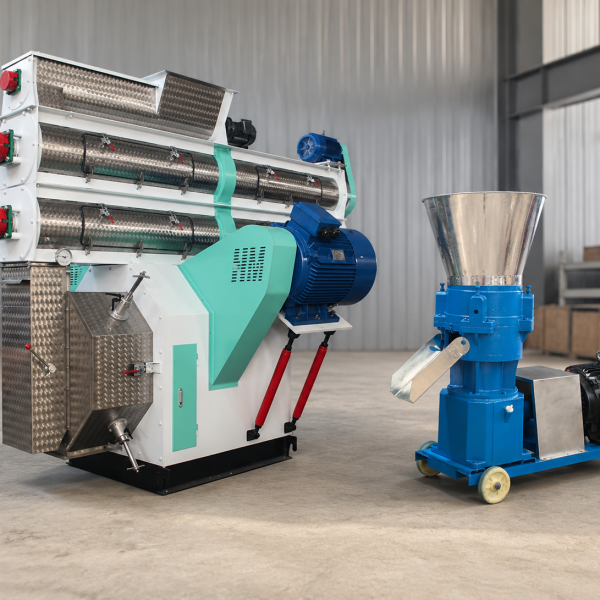
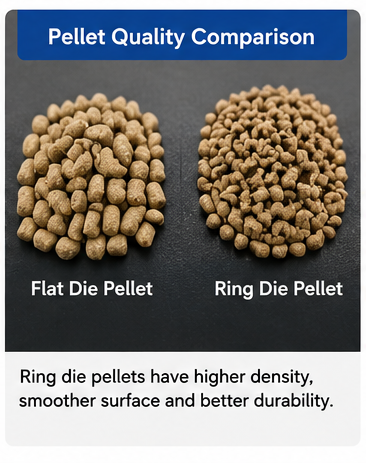
A plant targeting 5–20 tons per hour with long daily operating hours should normally use an industrial ring die feed pellet mill.
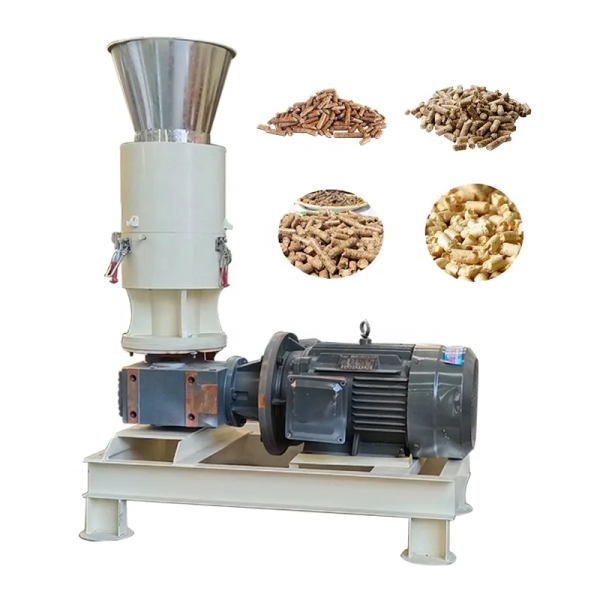
Flat die pellet mills remain useful for farms, pilot production, special pellet shapes, low-volume formulas and operations that need simple die changes. Large industrial flat die systems also exist, so it would be inaccurate to classify every flat die machine as small. For mainstream compound feed plants in the 5–20 TPH range, however, ring die technology remains the more common and lower-risk choice.
Why 5–20 TPH Feed Plants Usually Use Ring Die Pellet Mills
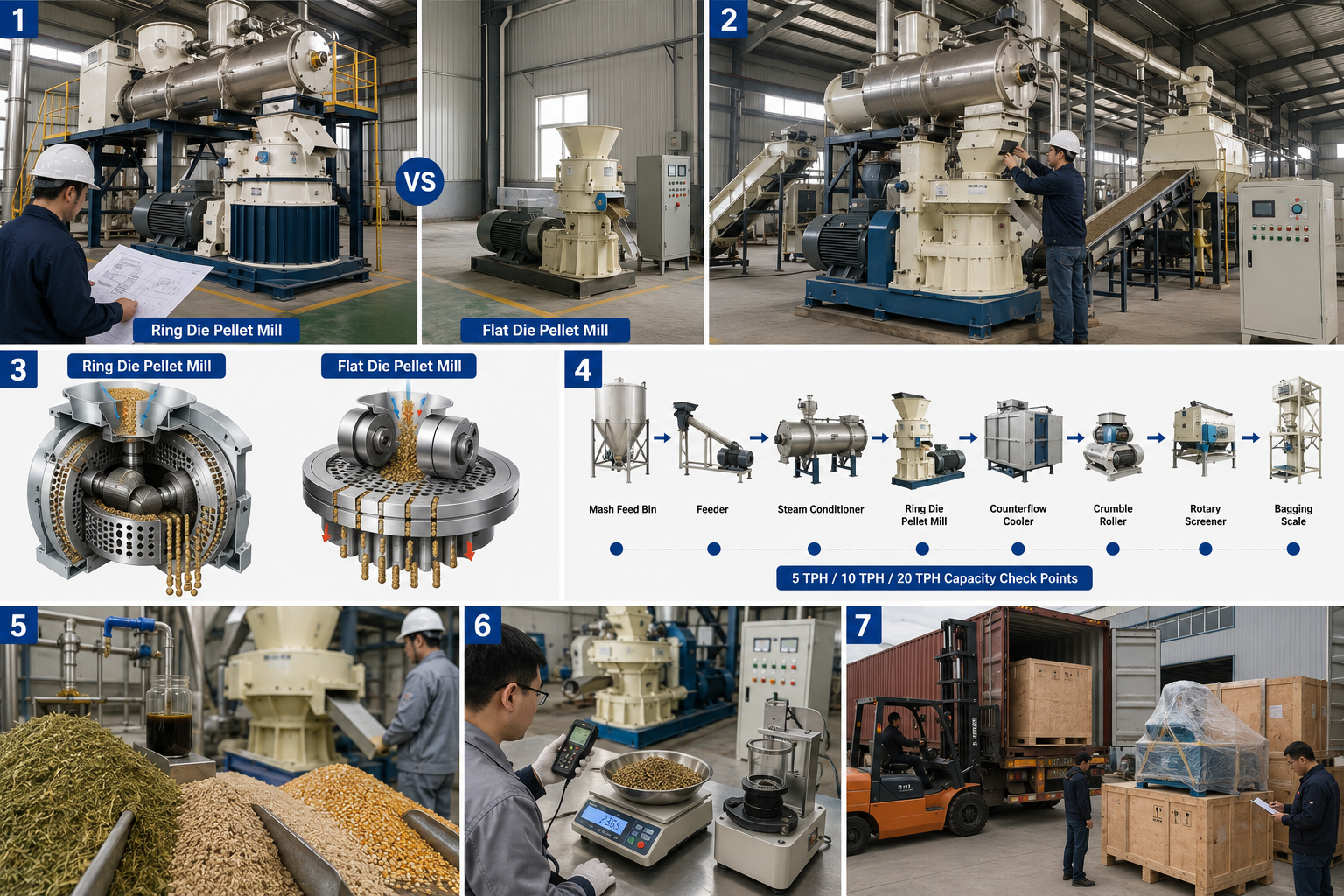
A ring die pellet mill is not selected only because it has a larger motor. Its main advantage is its ability to operate as part of a continuous process that includes controlled feeding, steam conditioning, pelleting, cooling, crumbling, screening and automatic process control.
Current industrial ring die product ranges cover capacities such as 5–35 TPH and 15–60 TPH, depending on the model and feed type.[1][2] This places a 5–20 TPH feed project directly within the normal operating range of commercial ring die machines.
A ring die pellet mill is normally better suited to a plant with the following requirements:
* Two-shift or three-shift production;
* Stable operation for 16–24 hours per day;
* Commercial poultry, pig or cattle feed;
* Automatic adjustment of feeding rate according to main motor load;
* Controlled steam conditioning;
* Defined pellet durability and fines targets;
* Centralized PLC operation;
* Future capacity expansion.
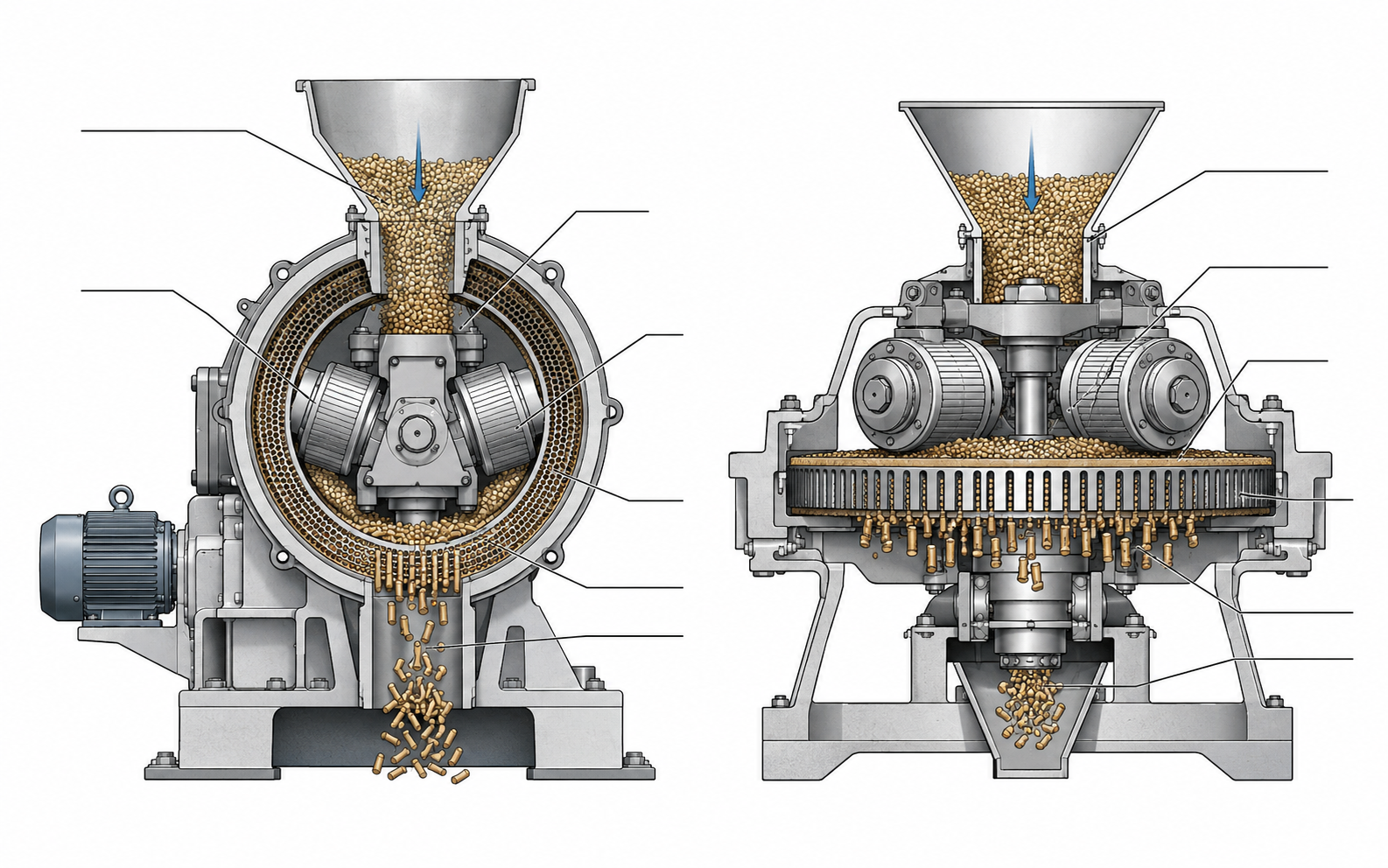
The ring die provides a relatively large effective pelleting area. Feed can be distributed continuously across the inner surface of the die, while the rollers press the conditioned mash through the die holes.
This structure is well established in commercial feed plants. It is also easier for an equipment manufacturer to match the pellet mill with a conditioner, cooler, crumbler, screener and conveying system using proven production data.
Can a Flat Die Pellet Mill Produce More Than 5 TPH?
The answer cannot be reduced to a simple “no.”
Industrial flat die machines are available with large die diameters, multiple pan grinder rollers, hydraulic pressure control and motors rated at several hundred kilowatts. Some manufacturers use these systems for compound feed, fibrous products and special pellet shapes.[4]
In biomass applications, certain large flat die machines can reach approximately 12 TPH. That figure must not be copied directly into an animal feed project. Wood pellets and compound feed have different raw material properties, die compression requirements, conditioning methods and finished product standards.[4]
Most flat die feed pellet mills offered in the general export market are designed for:
* Family farms;
* Small feed workshops;
* Agricultural cooperatives;
* Intermittent production;
* Projects without a steam boiler;
* Diesel, PTO or small electric motor operation;
* Frequent production of small batches.
A standard small flat die machine is simple, compact and relatively inexpensive. Those advantages become less decisive once the target reaches 5–20 TPH.
Combining multiple small flat die machines does not automatically create an efficient industrial line. The plant would need to control feeding across several machines, monitor uneven die wear, maintain consistent pellet quality and coordinate the combined discharge with one cooler and packaging section.
The calculated capacity may look acceptable on paper, while the actual production system becomes labor-intensive and difficult to balance.
Selecting Equipment for a 5 TPH Feed Plant
Five tons per hour sits between a small commercial plant and a medium industrial feed line.
A large industrial flat die system may be considered when the plant operates for only a few hours per day, uses a limited number of formulas and values simple changeovers. This should be treated as a specific engineering assessment rather than a general recommendation.
An industrial ring die pellet mill is usually the safer choice when the project involves:
* Two or three production shifts;
* Commercial feed sold to external customers;
* Steam conditioning;
* Poultry or pig feed;
* Defined pellet durability requirements;
* Future expansion to 8–10 TPH;
* Automated batching and packaging.
The purchase contract must define what “5 TPH” means.
It may refer to:
* Mash entering the pellet mill;
* Hot pellets leaving the die;
* Cooled pellets before screening;
* Acceptable finished pellets after screening;
* Packed product leaving the bagging machine.
These are not the same measurement points.
If fines, oversized pellets, startup losses and recycled material are excluded from the calculation, a pellet mill may meet its nominal capacity while the packaging section delivers less than 5 tons of saleable feed.
Selecting Equipment for an 8–12 TPH Feed Plant
The 8–12 TPH range is a standard application for industrial ring die pellet mills.
A poultry or pig feed plant may use one pellet mill matched to the full required capacity. The plant can also use two smaller machines when production redundancy is important.
A single-machine arrangement offers:
* Lower initial investment;
* Fewer conveyors and control points;
* Simpler operation;
* Smaller building requirements.
Its main weakness is production dependency. When the pellet mill requires a die change, roller adjustment or bearing maintenance, the complete pelleting section may stop.
A dual-machine arrangement offers:
* Partial production during maintenance;
* Easier separation of different feed formulas;
* Greater scheduling flexibility;
* Capacity expansion in stages.
The disadvantages are higher investment, more floor space, additional conditioners and a more complex control system.
Ruminant feed requires separate evaluation. One specialized ring die machine reports approximately 9–12 TPH when processing formulas containing 20%–40% hay powder.[3] This example shows why poultry feed capacity cannot be copied into a cattle feed project.
For a high-fiber formula, the production director should check:
* Hay or straw inclusion;
* Fiber length;
* Raw material bulk density;
* Molasses percentage;
* Forced-feeding requirements;
* Conditioner configuration;
* Die hole diameter;
* Effective die compression ratio;
* Roller shell pattern;
* Cooler capacity.
The main motor may have enough power, but the plant can still fail to reach target output if low-density material does not enter the pelleting chamber evenly.
Selecting Equipment for a 15–20 TPH Feed Plant
A 15–20 TPH project is a full industrial feed production line.
Using several standard flat die machines to reach the required total capacity is rarely the most efficient arrangement. The normal choices are:
* One large ring die pellet mill rated for the required formula and output;
* Two medium ring die machines operating in parallel;
* Two pellet mills assigned to different product groups.
A single large machine reduces floor space, operator requirements and control complexity. Its weakness is the concentration of production risk. A main machine failure can stop the complete pelleting line.Two medium machines require more investment but improve redundancy. One machine can continue producing while the other undergoes planned maintenance. The plant can also allocate one machine to poultry feed and the other to pig or ruminant formulas.
The correct decision depends on more than hourly output. The financial calculation should include:
* Planned annual production;
* Number of formulas;
* Required product changeovers;
* Maintenance intervals;
* Cost of one hour of downtime;
* Local spare-parts availability;
* Future expansion plans.
For a factory that cannot tolerate a complete shutdown, two pellet mills may be economically justified even when one large machine has enough nominal capacity.
Application Scenario 1: A 10 TPH Poultry Feed Plant
Consider an overseas customer planning a 10 TPH plant for broiler and layer feed. The main materials are corn, soybean meal, wheat bran, oil and premix. The plant will operate 16 hours per day and produce 3 mm pellets, 4 mm pellets and crumbled starter feed.
A practical pelleting section would include:
* Variable-speed feeder;
* Steam conditioner;
* Industrial ring die pellet mill;
* Counterflow cooler;
* Pellet crumbler;
* Grading screen;
* Fines return system;
* Automatic weighing and bagging machine.
The customer may ask whether two lower-cost flat die machines can produce the same combined output.
The first problem is not the sum of their rated capacities. The problem is whether both machines can maintain the same output, pellet density, electrical load and wear condition throughout a full shift.
When one machine loses capacity because of die wear or uneven feeding, the combined discharge becomes unstable. The cooler receives fluctuating material flow, the screener operates unevenly and the packaging machine cannot maintain a consistent rate.
For feed sold commercially, production stability is more valuable than the theoretical addition of several machine capacities.
Application Scenario 2: A 10 TPH High-Fiber Ruminant Feed Plant
A second customer wants to produce cattle and sheep pellets containing hay powder, straw, grain by-products and molasses.The customer finds a pellet mill advertised at 12 TPH for poultry feed and asks the supplier to guarantee the same output for the cattle formula.That guarantee should not be accepted without formula analysis or a production test.Hay and straw reduce bulk density. Long fibers may bridge inside bins and feeders. Molasses changes material friction, pellet temperature and cooling behavior. A standard poultry pellet mill can have sufficient motor power while still lacking the correct feeding and conditioning system for the formula.
A more suitable configuration may require:
* Forced feeder;
* Conditioner designed for low-density material;
* Liquid or molasses addition system;
* Ring die selected for high-fiber feed;
* Specialized roller shells;
* Controlled die-to-roller clearance;
* Larger cooling and screening capacity.
The contractual capacity should be linked to a defined formula, moisture range, hay inclusion rate, pellet diameter and steam condition.
Without these conditions, the phrase “10 TPH feed pellet mill” has limited engineering value.
Five Purchasing Risks That Directly Affect Output
Risk 1: Treating Maximum Output as Guaranteed Output
A capacity range in a brochure normally reflects selected operating conditions. The upper figure may have been achieved with an easy-to-pellet formula, a larger die hole, stable steam and a new die.The contract should define:
* Test formula;
* Raw material moisture;
* Pellet diameter;
* Steam pressure and quality;
* Continuous test duration;
* Method used to calculate acceptable output;
* Maximum fines percentage;
* Pellet durability target;
* Procedure if the capacity test fails.
A statement such as “capacity: 10–15 TPH” is not a complete performance guarantee.
Risk 2: Oversizing the Pellet Mill and Undersizing the Line
A pellet mill capable of producing 20 TPH does not create a 20 TPH production line by itself.
The actual bottleneck may be:
* Feeder;
* Conditioner;
* Boiler;
* Steam piping;
* Cooler;
* Crumbler;
* Screener;
* Elevator;
* Conveyor;
* Bagging machine.
The supplier should submit a material balance showing the rated throughput of every machine in the pelleting section.A production director should also ask how much recycle flow has been included. A screen handling 20 TPH of finished pellets may need to process more than 20 TPH when returned fines are included.
Risk 3: Selecting the Die Only by Hole Diameter
Two ring dies with 4 mm holes can produce different capacity, energy consumption and pellet quality.
Relevant factors include:
* Effective hole length;
* Compression ratio;
* Relief depth;
* Inlet geometry;
* Steel grade;
* Heat treatment;
* Open area;
* Hole distribution.
The correct die must match the feed formula. High-fiber cattle feed, high-fat poultry feed and mineral-rich feed do not require identical die designs.A buyer should submit the major raw material percentages for at least the main three formulas. “Chicken feed” or “cattle feed” alone does not provide enough information.
Risk 4: Ignoring Voltage, Frequency and Site Conditions
A standard electrical configuration produced for the Chinese market may not match the destination country.
The buyer should confirm:
* Three-phase voltage;
* 50 Hz or 60 Hz;
* Control voltage;
* Permitted grid fluctuation;
* Site altitude;
* Ambient temperature;
* Dust level;
* Required motor efficiency class;
* Required enclosure protection.
Frequency affects motor speed, feeder speed, ring die speed and fan performance. A machine designed for 380 V, 50 Hz should not be changed to 440 V, 60 Hz after manufacturing without reviewing the motors, pulleys, gear ratios and electrical components.Depending on the contract and local regulations, the machine electrical system may be designed with reference to IEC 60204-1. Motor ratings and performance are covered by the IEC 60034 series, while enclosure IP classifications are defined through IEC 60529.Compliance requirements must be written into the purchase specification. The word “IEC” by itself is not a complete technical requirement.
Risk 5: Failing to Calculate Spare-Parts and Downtime Costs
The lowest equipment quotation may not produce the lowest annual cost.
Before placing an order, the buyer should confirm:
* Expected die and roller life;
* Price of one die and roller set;
* Number of workers required for replacement;
* Availability of a die lifting device;
* Bearing and oil seal brands;
* Availability of equivalent parts in the destination country;
* Supplier delivery time for urgent parts;
* Recommended two-year spare-parts package.
For an overseas feed plant, lead time can matter more than the price of one component. A low-cost sensor, seal or bearing can stop production for several days when no replacement is available locally.
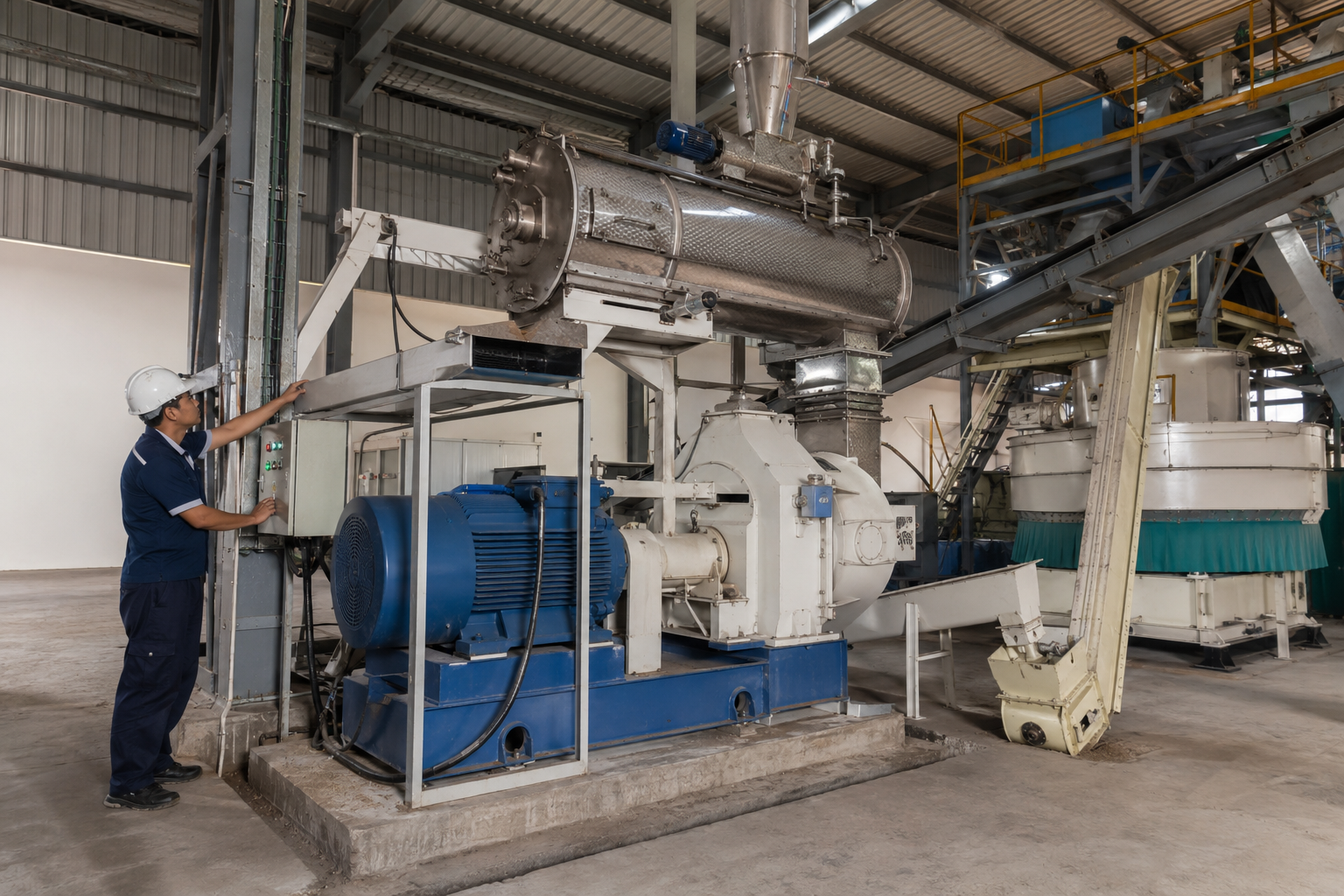
Export Packing and International Delivery
An industrial pellet mill for a 5–20 TPH line is not handled like a small farm machine.
The main machine, conditioner, feeder, motor, control cabinet and service platform may need to be packed separately. Before shipment, the buyer should verify:
* Marked lifting points;
* Center-of-gravity labels;
* Anti-rust protection for dies and rollers;
* Moisture protection for electrical cabinets;
* Reinforcement of components inside the control cabinet;
* Protection of motor shafts and machined surfaces;
* Compliant wooden packaging;
* Box numbers matching the packing list;
* Desiccants and moisture-barrier film for long sea transport;
* Reliable securing inside the container;
* Separate packing for bolts, gaskets and installation accessories.
Many overseas installation delays are caused by documentation and packing errors rather than machine design.
The delivery package should include:
* General arrangement drawing;
* Foundation drawing;
* Electrical schematic;
* Terminal and wiring drawings;
* Packing list;
* Spare-parts list;
* Lubrication schedule;
* Installation manual;
* Commissioning procedure;
* Alarm code list.
Every package should be linked to the drawing and equipment identification system used by the installation team.
FAT Requirements for a 5–20 TPH Pellet Mill
A ten-minute no-load run does not demonstrate production capacity.Factory Acceptance Testing should be divided into mechanical inspection, electrical inspection and loaded performance testing.
Mechanical Inspection
The inspection should cover:
* Machine model and nameplate;
* Die hole diameter and die identification;
* Roller quantity and roller shell pattern;
* Die-to-roller clearance adjustment;
* Lubrication system;
* Guards and access doors;
* Die lifting arrangement;
* Rotation direction;
* Fasteners;
* Welding and surface quality.
Electrical and Safety Inspection
The FAT should verify:
* Motor voltage and frequency;
* Electrical component brands;
* Emergency stops;
* Safety-door interlocks;
* Overload protection;
* Phase-loss and phase-sequence protection;
* Blockage detection;
* Bearing temperature monitoring;
* Main motor current display;
* Variable-frequency drive parameters;
* PLC input and output signals;
* Interlocks with upstream and downstream machines.
Loaded Performance Test
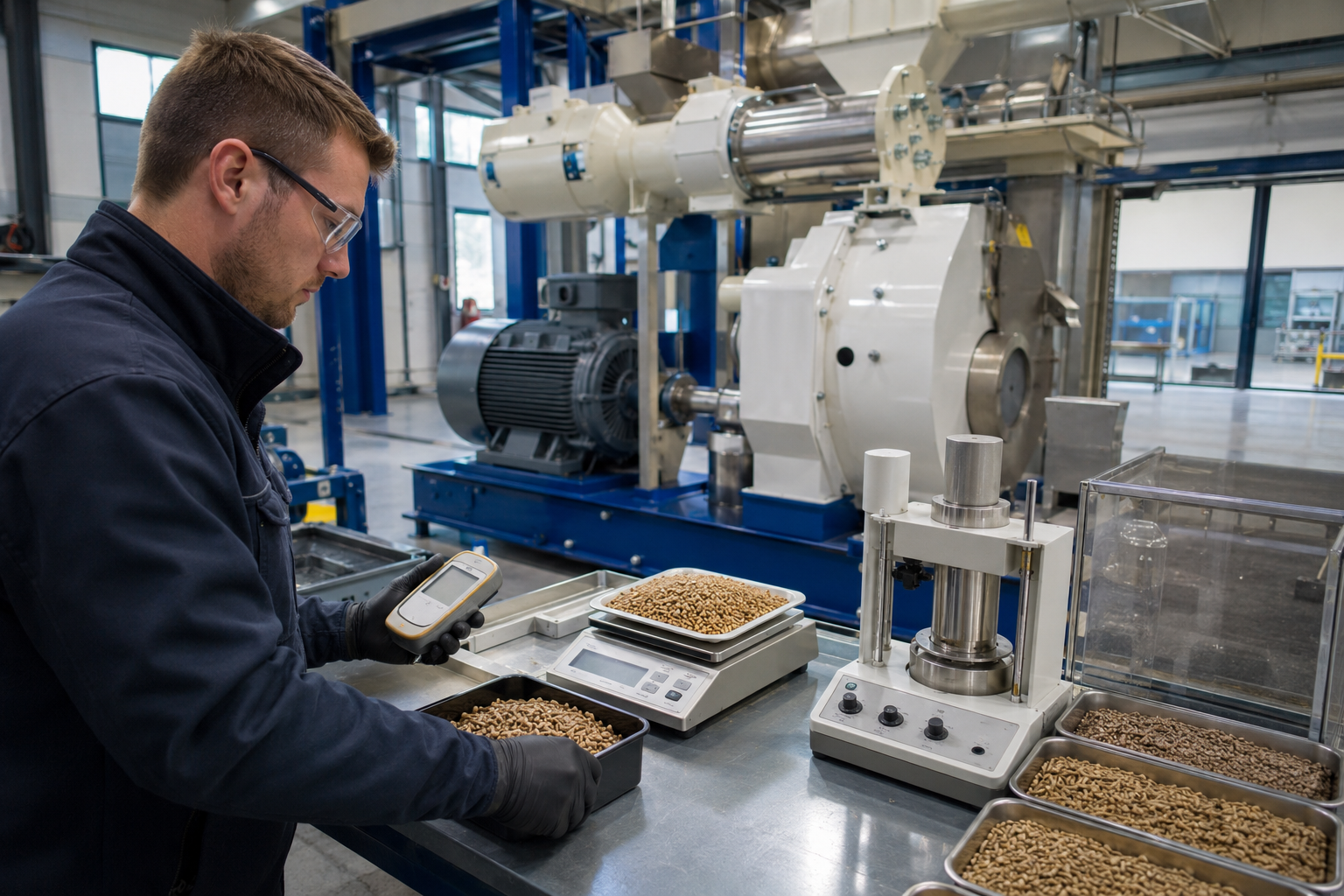
The most useful FAT uses the customer’s raw materials or a substitute formula with similar fiber, fat and moisture characteristics.
The recorded data should include:
* Actual hourly output;
* Continuous test duration;
* Average motor current;
* Peak motor current;
* Specific energy consumption;
* Steam pressure;
* Steam consumption;
* Moisture before and after conditioning;
* Conditioning temperature;
* Pellet discharge temperature;
* Pellet diameter and length;
* Fines percentage;
* Pellet Durability Index;
* Bearing temperatures;
* Vibration;
* Alarm and blockage events.
A short demonstration with an easy local formula should not be presented as proof that the machine will meet capacity on the buyer’s high-fiber or high-fat formula.When the manufacturer cannot obtain the customer’s ingredients, the contract should define a substitute formula and a second performance test at the customer’s site. The responsibility, measurement method and acceptance limit must be agreed before production begins.
Call to Action
For a 5–20 TPH feed pellet production line, send us your feed formulas, target pellet diameter, daily working schedule, voltage, building dimensions and packaging requirements.Our engineering team can prepare a ring die pellet mill selection, complete line material balance, steam requirement, equipment layout, FAT plan and export packing list based on your actual production conditions—not only a nominal capacity printed on a quotation.