
Home » News » What Is the Best Oil Press Machine for Sunflower Seeds and Sesame Seeds?
What Is the Best Oil Press Machine for Sunflower Seeds and Sesame Seeds?
For a small or medium-sized oil mill that plans to process both sunflower seeds and sesame seeds, the best machine is usually not the cheapest multi-seed press listed in an online catalogue.
Both materials can be mechanically pressed, but they do not behave in the same way inside the machine. Sunflower seeds contain a relatively high proportion of hulls, while sesame seeds are smaller and require more precise feeding and pressure control. A sunflower oil business normally focuses on continuous throughput and production cost. A sesame oil producer may place greater value on aroma, colour, batch consistency, and temperature control.
For most commercial projects processing approximately 1 to 10 tonnes of oilseeds per day, the most practical solution is:
A continuous screw oil press equipped with adjustable cake clearance, variable-speed feeding, temperature-controlled conditioning, and a separate oil filtration system.
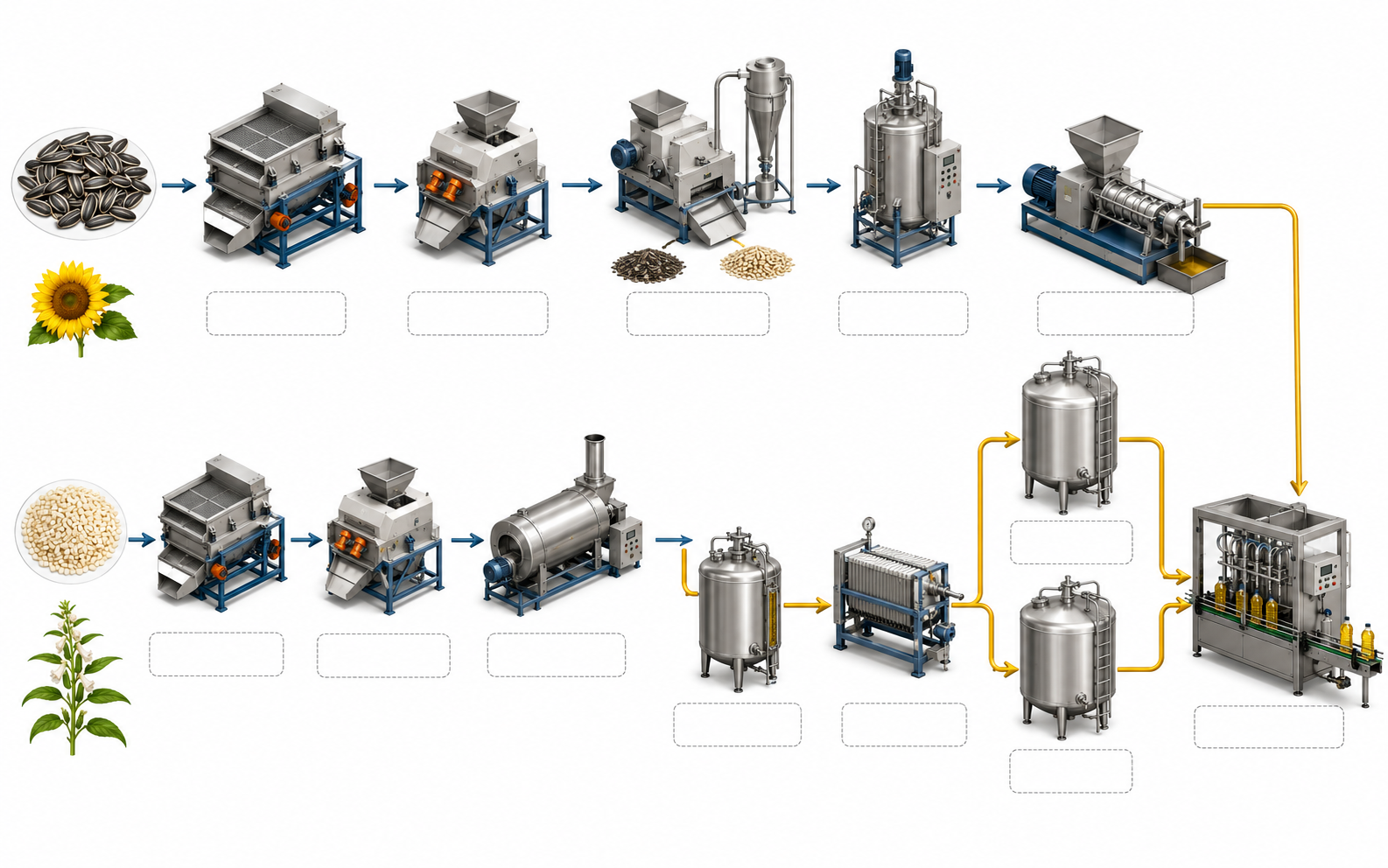
The press should be installed as part of a line that includes seed cleaning, optional sunflower dehulling, sesame roasting or conditioning, oil clarification, storage, and packaging.
The same screw press may process both materials, but the seeds should not be run under identical settings. Feed rate, screw speed, barrel temperature, cake thickness, and seed preparation must be adjusted for each product.
A hydraulic press may be more appropriate when the main product is premium, small-batch sesame oil. A larger industrial expeller or pre-press line is more suitable when sunflower seed is the primary raw material and high daily throughput is the commercial priority.
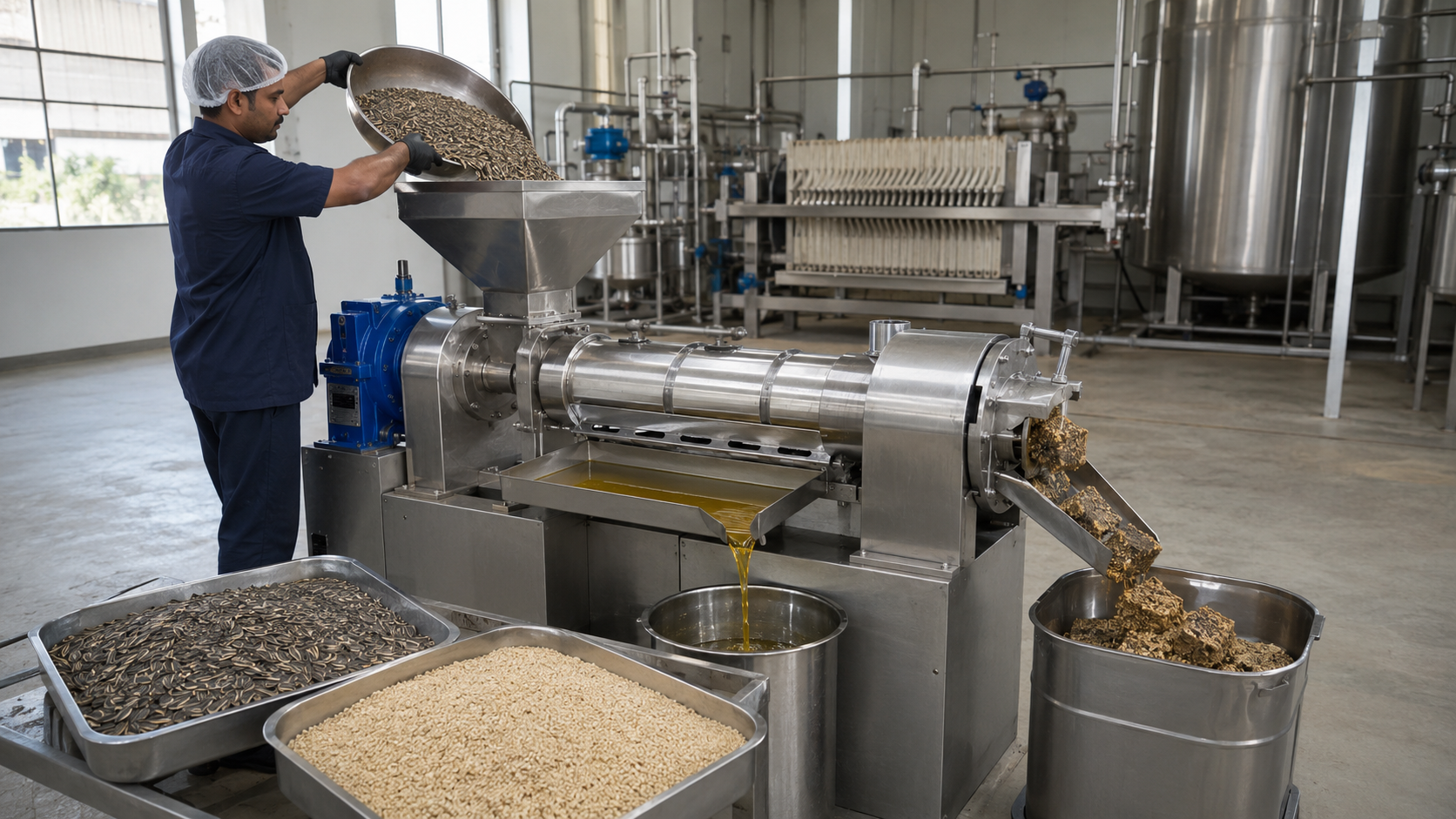
Can One Oil Press Process Both Sunflower and Sesame?
Technically, yes. Commercially, the answer depends on the required capacity, oil quality, cleaning procedure, and product positioning.
Many oil press suppliers advertise one machine for peanuts, rapeseed, soybeans, sunflower seeds, sesame, flaxseed, and other materials. This description only confirms that the press can generate enough mechanical pressure to extract oil from different seeds. It does not confirm that every material will achieve the same throughput, oil recovery, temperature, or wear rate.
A buyer should examine four major differences.
1、Sunflower Seeds Contain More Hull Material
Whole sunflower seeds contain a significant fibrous hull fraction. When all hulls enter the press, the machine must handle more low-oil fibre, and the crude oil may carry more fine solids.
Small processors sometimes press cleaned whole sunflower seeds because the process is simple and requires less investment. A commercial plant may install a dehuller and kernel separator to improve material preparation and control the composition of the press cake.
The decision should depend on seed variety, hull percentage, desired meal quality, and the economics of the project. A supplier should not claim that dehulling is either always necessary or never necessary without reviewing the raw material.
2、Sesame Requires Stable, Controlled Feeding
Sesame seeds are small and flow easily. A poorly designed hopper, feeder, screw profile, or press-bar gap can allow seeds to leak through the press or pass without sufficient compression.
A machine that performs well with peanuts or rapeseed may still require a different feed rate or internal adjustment for sesame. Buyers should request a loaded test using sesame rather than accepting data taken from another oilseed.
3、Sesame Oil Quality Depends Strongly on Pretreatment
Roasted sesame oil requires a controlled roasting process to develop its characteristic aroma and colour. Excessive heat or uneven roasting can create burnt flavours and inconsistent batches.
Cold-pressed sesame oil follows a different process. The processor must control seed temperature, press temperature, screw speed, and residence time. The same press may produce both styles, but the upstream equipment and operating parameters cannot be identical.
4、Sunflower Processing Is Usually More Throughput-Driven
Sunflower oil is commonly sold as a higher-volume edible oil. Profitability may depend on stable feeding, long operating hours, energy consumption per tonne, and the value of the remaining meal.
Sesame oil often sells at a higher unit price. A producer may accept lower throughput when the process delivers a specific aroma, colour, or premium product claim.
When one line processes both seeds, the owner should identify the main commercial product first. Trying to optimise the machine equally for every oilseed often results in a compromise that performs poorly on the most important material.
Which Type of Oil Press Is Best?
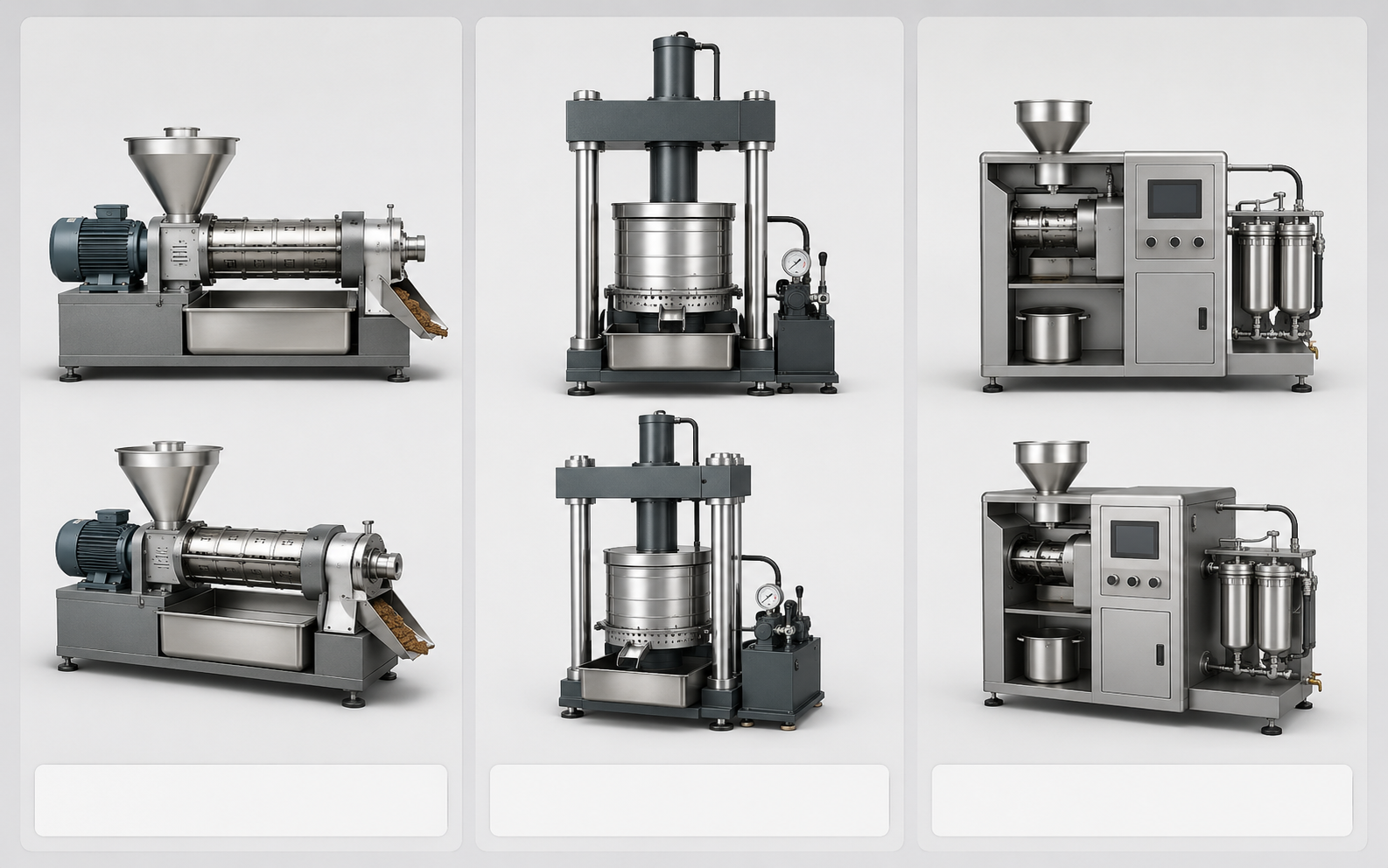
Continuous Screw Oil Press
A screw oil press moves the prepared seeds through a compression chamber. As the available space decreases, pressure separates the oil from the solid cake.
This design is normally the first choice for a commercial plant that needs continuous production and intends to process both sunflower and sesame. It can be connected to cleaners, dehullers, cookers, conveyors, filters, tanks, and filling machines.
The main purchasing points include:
- Screw and press-bar material
- Heat treatment and wear resistance
- Adjustable cake outlet clearance
- Variable-frequency control for the feeder or main shaft
- Temperature monitoring or barrel heating
- Food-contact material specifications
- Access for cleaning and dismantling
- Availability of sunflower and sesame test data
- Spare screw, press-bar, bearing, seal, and filter-cloth supply
A screw press produces frictional heat during operation. This does not automatically make it unsuitable for premium oil, but buyers using a “cold-pressed” product claim must define the temperature requirement.
The contract should identify where the temperature is measured, whether the reading refers to the seed, press chamber, or discharged oil, and under what production load the limit applies.
A general statement that a machine has a “cold-press function” is not a measurable acceptance condition.
Hydraulic Oil Press
A hydraulic press operates in batches. Prepared material is loaded into the chamber, pressure is applied for a defined period, and the cake is removed before the next batch.
This machine is commonly considered for roasted sesame and other high-value oils. It offers several operational advantages:
- Clear separation between production batches
- Straightforward observation of each batch
- Suitability for speciality and traditional-style oils
- Simple expansion by installing several presses
- Lower dependence on continuous feeding equipment
Its limitations are equally important:
- Lower throughput per machine
- More loading and unloading labour
- Less suitable for high-volume sunflower processing
- More floor space and operators when several units are installed
- Batch-to-batch variation if preparation is not controlled
A hydraulic machine can be appropriate when sesame represents most of the raw material and the business sells a high-margin speciality oil. It is usually not the best main machine for a sunflower oil operation that must process several tonnes per shift.
Integrated Automatic Oil Press
An integrated oil press may combine heating, pressing, and basic filtration on one frame. It requires less floor space and can often be commissioned quickly.
This format is suitable for:
- Farm processing
- Retail oil shops
- Market testing
- Sample production
- Very small start-up operations
The concern is not whether the machine can produce oil. The concern is whether it can maintain the advertised output over a full working shift.
Some published capacities are based on a short test using a favourable oilseed and high preheating temperature. During longer production, filter blockage, cake discharge, gearbox temperature, and manual cleaning can reduce the net output.
An integrated machine should be treated as entry-level equipment unless the supplier can provide credible long-duration production data.
Industrial Expeller or Pre-Press Line
When sunflower seed throughput becomes much higher, a single compact press may no longer provide the lowest processing cost.
A large sunflower project may include cleaning, dehulling, cracking, flaking, cooking, mechanical pre-pressing, oil clarification, and refining. Some very large plants combine pre-pressing with solvent extraction to reduce residual oil in the meal.
Such projects require specialised engineering, safety systems, environmental controls, and site permits. They are not simply larger versions of a small screw press line.
For an agricultural start-up or regional distributor, beginning with a large extraction complex can create excessive capital and operating risk. A modular mechanical pressing line is usually easier to commission and expand.
Equipment Comparison
| Equipment | Best-Suited Material | Typical Application | Main Advantage | Main Limitation |
| Continuous screw press | Sunflower, sesame, and multiple oilseeds | Small and medium commercial mills | Continuous production and flexible configuration | Frictional heat and parameter adjustment |
| Hydraulic press | Sesame and premium oils | Small-batch speciality production | Good batch control | Lower capacity and more labour |
| Integrated oil press | Cleaned oilseeds | Farms, shops, and pilot production | Compact and easy to install | Limited filtration and continuous-duty performance |
| Industrial pre-press line | Mainly sunflower and bulk oilseeds | Medium and large oil factories | High throughput and lower unit cost | Higher investment and engineering complexity |
Recommended Production-Line Configuration
The oil press is only one part of a reliable plant. Buying only the main press may reduce the initial quotation, but it often transfers cost to labour, downtime, filtration losses, and inconsistent oil quality.
1、Seed Cleaning
The line should remove dust, stalks, stones, metal, and other foreign material before pressing.
Stones and metal pieces can damage the screw, press bars, bearings, and gearbox. Fine dust passes into the crude oil and increases the load on the filtration system.
A small line may use a vibrating screen and destoner. A larger plant may add aspiration, magnetic separation, and automatic feeding.
2、Sunflower Dehulling
Dehulling is not compulsory for every project, but it should be evaluated.
Pressing whole sunflower seeds simplifies the line. Installing a dehuller and hull-kernel separator increases capital cost but allows the processor to control the amount of fibre entering the press.
The decision affects throughput, oil clarification, energy consumption, and the commercial value of the cake. Suppliers should review the seed sample or at least the expected hull percentage before recommending a configuration.
3、Sesame Roasting or Conditioning
A producer of aromatic sesame oil normally needs a roaster with controlled heating, mixing, and discharge.
Uniform treatment is more important than simply reaching a high temperature. Hot spots can burn part of the batch while leaving other seeds under-roasted.
A low-temperature product requires a different conditioning strategy. Lower processing temperature may preserve a particular flavour profile, but it can also reduce throughput or oil recovery. The commercial decision should compare the expected selling price with the additional raw-material and processing cost.
4、Mechanical Pressing
The press should be selected based on the most demanding major raw material, not on the easiest seed listed in the catalogue.
When the plant changes regularly between sunflower and sesame, the press should provide convenient access to the barrel, screw, oil tray, and cake outlet. A highly enclosed machine that is difficult to clean may create flavour carryover between products.
5、Oil Clarification and Filtration
Freshly pressed crude oil normally contains fine solids. Natural settling requires little equipment but needs tanks, time, and careful transfer of the clear oil.
A plate-and-frame filter is widely suitable for small and medium plants. Filter cloth can be inspected and replaced, and the filtration process is relatively easy to understand.
A vacuum filter is compact, but buyers should check its real flow rate, cleaning frequency, consumable filter cost, and performance with sesame and sunflower oil.
The filter should be sized according to the oil flow, not the seed feed rate. A 300 kg/h press does not produce 300 kg/h of oil.
6、Storage and Filling
Oil-contact tanks, pumps, pipes, valves, and filling nozzles should use appropriate food-processing materials and be designed for cleaning.
When sunflower oil and sesame oil are both produced, separate storage tanks and product lines help prevent flavour carryover. Shared piping may appear cheaper but can create cleaning delays and mixed batches.
Recommended Capacity by Business Scale
| Raw-Material Throughput | Suggested Configuration | Suitable Business |
| 20–50 kg/h | Compact screw press, basic cleaning, simple filtration | Farm, shop, or market trial |
| 80–300 kg/h | Continuous screw press, cleaner, roaster or conditioner, plate filter | Start-up mill and local wholesaler |
| 300–800 kg/h | Industrial screw press, automatic feeding, sunflower dehulling, separate sesame roasting, filtration and storage | Small or medium commercial oil mill |
| Above 1,000 kg/h | Multiple presses or engineered pre-press line with automatic control | Regional processing and distribution |
These capacities are planning references, not guaranteed performance values. Actual output depends on seed variety, moisture, impurity level, hull content, preparation, press temperature, and required cake condition.
Application Scenario 1: Sunflower-Focused Regional Oil Mill
Consider a regional processor operating one eight-hour shift. Sunflower seeds represent 70% of the raw material, while sesame represents 30%. The finished oils are sold to supermarkets, restaurants, and local food manufacturers.
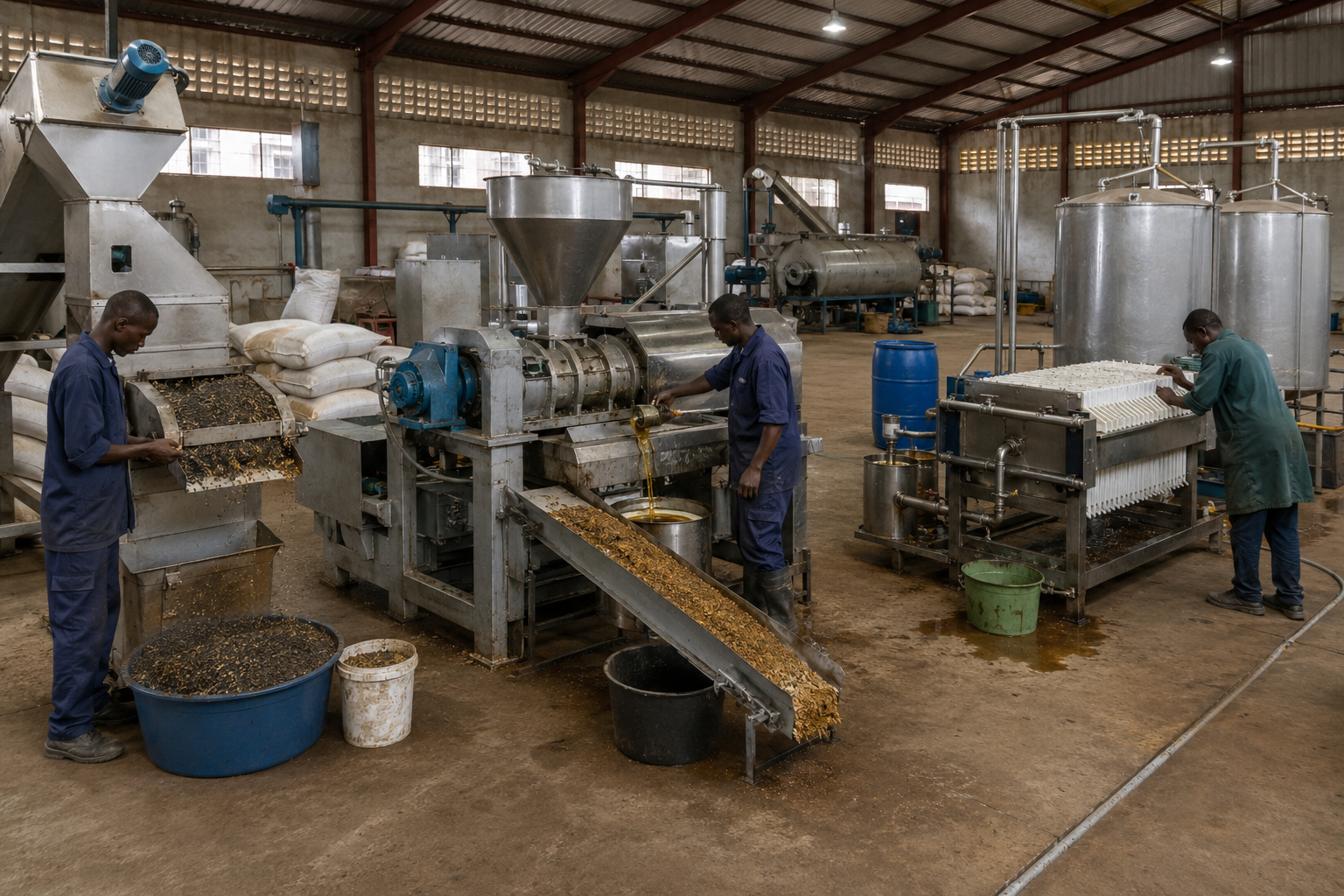
A practical line may include:
Vibrating cleaner and destoner
Sunflower dehuller and separator
Separate sesame roaster
Buffer hopper and variable-speed feeder
Medium industrial screw oil press
Plate-and-frame filter
Separate sunflower and sesame storage tanks
Semi-automatic filling machine
Production should be scheduled in longer campaigns rather than changing seeds repeatedly during one shift. Before sesame processing, the operator should empty the remaining sunflower material and clean the press barrel, oil tray, filter, and transfer system.
The main procurement question is not whether the press can process both seeds. The buyer should evaluate changeover time, cleaning access, actual output for each seed, oil carryover, and spare-part wear.
A slightly more expensive machine with faster dismantling may save more money than a lower-priced press that requires several hours to clean.
Application Scenario 2: Premium Sesame Oil Start-Up
A small agricultural processing company plans to purchase sesame from local farmers and sell aromatic sesame oil to restaurants, speciality stores, and online customers. It may also produce a limited volume of cold-pressed oil.
A reasonable initial configuration is:
Sesame cleaner and destoner
Temperature-controlled roaster
A 50–100 kg/h screw press or several small hydraulic presses
Small plate filter or precision filtration unit
Stainless-steel settling and storage tanks
Small-volume filling machine
This business depends more on batch traceability, aroma consistency, and sanitation than on maximum hourly throughput.
Buying an oversized press may create three problems: insufficient raw-material supply, long periods of low-load operation, and unnecessary capital tied up in equipment.
If sunflower oil may be introduced later, the owner can select a screw press that supports parameter adjustment and reserve floor space for future dehulling and conveying equipment.
How to Calculate the Required Press Capacity
Buyers should not divide the daily raw-material target by 24 hours unless the plant will genuinely press continuously for 24 hours.
Effective production time excludes warm-up, inspection, cleaning, seed changeover, filter service, and operator breaks. A plant scheduled for an eight-hour shift may have only six to seven hours of stable pressing time.
A useful initial calculation is:
Required rated capacity = Daily raw-material quantity ÷ Effective pressing hours × 1.15 to 1.25
The additional capacity provides a margin for raw-material variation, feeding interruptions, and moderate business growth. It does not justify automatically purchasing a machine twice as large as the current requirement.
The owner should calculate the complete processing economics:
- Seed purchase cost
- Filtered oil output
- Press-cake value
- Filtration loss
- Electricity or fuel consumption
- Labour requirement
- Wear-part cost
- Packaging expense
- Transport and distribution cost
- The lowest machine price does not necessarily deliver the lowest cost per tonne.
FAT and Performance Acceptance
The factory acceptance test should include mechanical inspection, electrical testing, and loaded process verification.
Mechanical Inspection
The buyer or inspector should check:
- Frame and weld condition
- Safety guards
- Screw rotation direction
- Gearbox and bearing noise
- Oil leakage
- Access for dismantling and cleaning
- Supplied tools and spare parts
- Machine nameplate and identification
Electrical Inspection
The electrical test should verify:
- Motor, feeder, heater, and pump ratings
- Control-panel component models
- Emergency-stop operation
- Overload protection
- Grounding continuity
- Cable identification
- Variable-speed adjustment
- Correspondence between drawings and actual wiring
Loaded Performance Test
The test record should include:
- Seed type and variety
- Seed moisture and impurity level
- Pretreatment method
- Input weight
- Continuous operating time
- Actual throughput
- Running current
- Press or oil discharge temperature
- Crude-oil weight
- Filtered-oil weight
- Cake weight and appearance
- Noise, vibration, leakage, and blockage observations
- A video is useful supporting evidence, but it should not replace a written test report. For a complete line, the buyer may attend the FAT or appoint an independent inspection company.
Export Packing and International Delivery
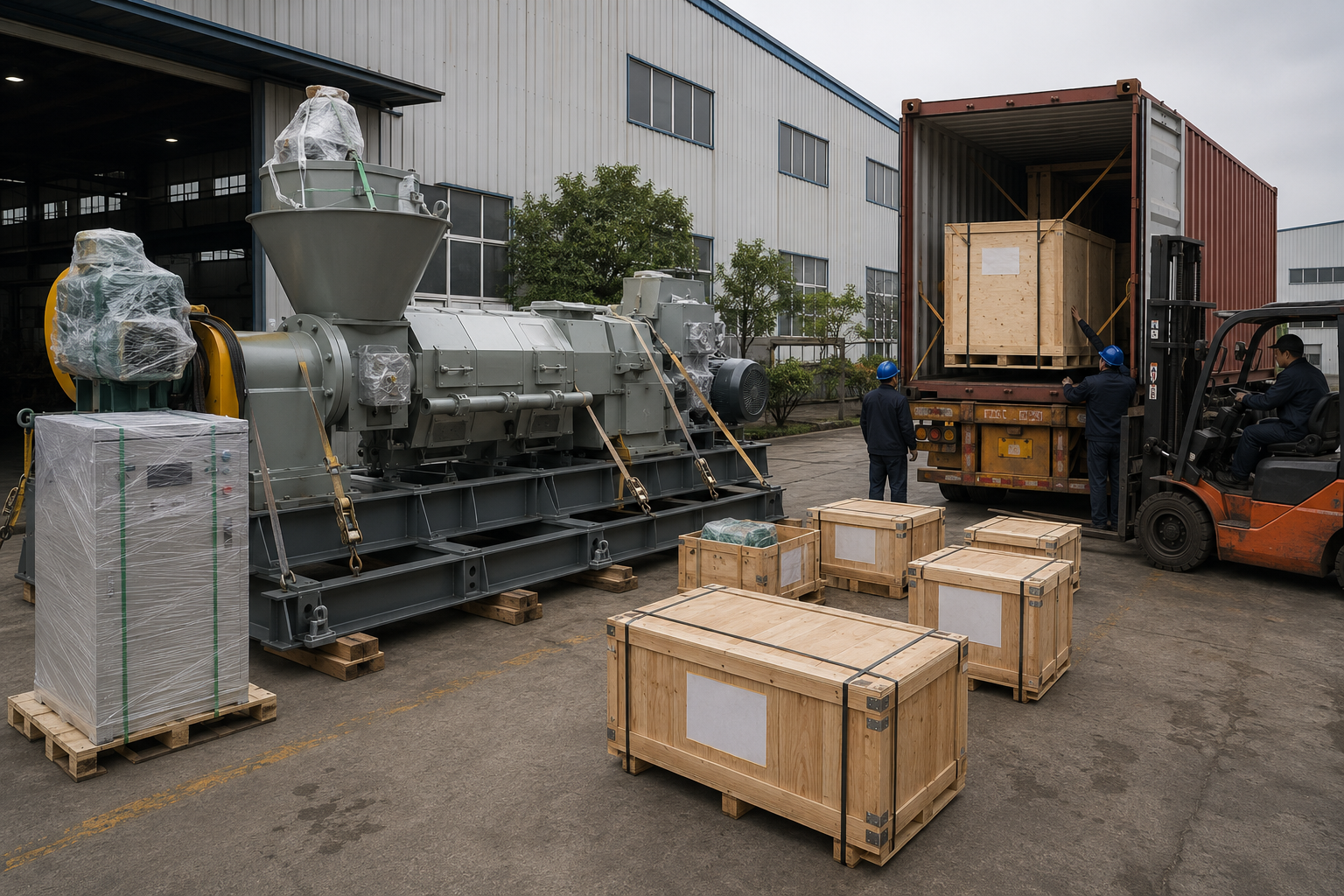
A complete line may include a cleaner, roaster, conveyor, press, filter, tanks, filling machine, and electrical control cabinet. The supplier should issue an equipment list, case numbers, dimensions, gross weights, and packing details.
Recommended export controls include:
- Secure fixing of heavy machines to reinforced bases
- Rust protection on exposed metal surfaces
- Moisture protection for motors and electrical cabinets
- Numbered packing for small components
- Covers for pipes, flanges, and openings
- Separate identification of tools and spare parts
- Compliant wooden packaging for the destination country
- Blocking and bracing inside the container
Before shipment, the buyer should receive photographs of the complete machines, nameplates, internal packing, closed cases, and container loading.
For a line requiring site installation, the documentation package should include:
- General arrangement drawing
- Foundation drawing
- Equipment layout
- Electrical diagram
- Cable and motor list
- Pipe connection drawing
- English operation manual
- Maintenance schedule
- Spare-parts list
Information Required for an Accurate Quotation
A professional quotation request should state:
- Main oilseeds and their expected proportions
- Whether sunflower seeds are hulled or unhulled
- Raw-material cleanliness and moisture
- Required hourly or daily capacity
- Planned working hours and shifts
- Cold-pressed, hot-pressed, or roasted-oil requirement
- Whether the product will be crude, filtered, or refined
- Intended use of the press cake
- Factory voltage, frequency, and phase
- Available workshop size and height
- Required automation level
- Bottle sizes and filling speed
- Destination country and nearest port
- FAT and third-party inspection requirements
- Spare-parts requirement
- Target commissioning date
This information allows the manufacturer to calculate the complete line rather than offering a generic press with an uncertain final cost.
FAQ
Can Sunflower Seeds and Sesame Be Pressed Without Cleaning?
This is not recommended. Dust increases filtration work, while stones and metal can damage the screw, press bars, and bearings. Commercial production should include screening and destoning.
Must Sunflower Seeds Be Dehulled?
Not in every project. A small plant may press cleaned whole seeds. Dehulling is more relevant when the processor wants better control of fibre entering the press, meal quality, oil clarification, or production efficiency.
Must Sesame Be Roasted Before Pressing?
No. Roasting is commonly used for aromatic sesame oil. Cold-pressed sesame oil requires a different low-temperature process. The two products have different flavour, colour, output, and market positioning.
How Long Does Product Changeover Take?
The time depends on the press design, residual material, and sanitation requirement. The supplier should demonstrate emptying, dismantling, and cleaning. Filters, pipes, pumps, and storage tanks must also be considered, not only the press chamber.
Is Cold Pressing Always Better Than Hot Pressing?
No single process is best for every market. Cold pressing may support a premium product position, but throughput or oil recovery may be lower. Conditioning or heating can improve oil release. The decision should be based on selling price, product specification, and processing economics.
How Can a Buyer Verify the Advertised Capacity?
Request a continuous loaded test with the target raw material. The report should record input weight, operating time, oil output, motor current, temperature, and cake condition. A short promotional video is not sufficient evidence.
Does the Plant Need Oil Refining Equipment?
A business selling filtered mechanically pressed oil may not require a complete refinery in some markets. Refining may be necessary when the product must meet defined requirements for colour, odour, acidity, impurities, stability, or wax content. The final decision must follow the regulations and product grade in the destination market.
Is a CE Mark Required?
For equipment supplied to the European market, the applicable machinery, electrical, safety, and documentation requirements must be evaluated for the complete scope of supply. A CE label or certificate for an individual component does not automatically demonstrate conformity of the complete production line.
Call to Action
To obtain an accurate sunflower and sesame oil press proposal, provide the raw-material condition, required capacity, finished-oil type, factory voltage, available space, and destination country.
The manufacturer should calculate separate throughput figures for sunflower and sesame and submit the pretreatment process, filtration configuration, power list, layout, spare-parts package, and FAT procedure.
A properly specified and tested production line reduces the risk of capacity shortfalls, voltage errors, filtration bottlenecks, product carryover, and costly modifications after international delivery.