
Home » News » Electric vs Diesel Wood Crusher: Pros, Cons, and Which to Choose

Electric vs Diesel Wood Crusher: Pros, Cons, and Which to Choose
Why Buyers Struggle to Choose Between Electric and Diesel Wood Crushers
As a Wood Recycling Center Owner, I frequently receive inquiries from customers who focus only on machine capacity while overlooking the actual operating environment.
A buyer may request a 15-ton-per-hour wood crusher and compare only the machine price. Several months later, they discover that fuel expenses, electricity availability, labor costs, and maintenance requirements have a much greater impact on profitability than the initial purchase price.
The question is not whether electric or diesel is better.
The real question is: Which power system creates the lowest processing cost per ton under your operating conditions?
The answer depends on location, feedstock source, mobility requirements, utility infrastructure, and production targets.
Let’s examine both options from a practical purchasing perspective.
A Real Purchasing Scenario from a Wood Recycling Center
Last year, a customer operating a wood recycling center in Eastern Europe contacted our factory.
Their incoming materials included:
- Construction wood waste
- Pallets
- Tree branches
- Furniture offcuts
Initially, they requested a diesel-powered wood crusher because they believed diesel engines always provide stronger performance.
After reviewing their site conditions, we found:
- Stable industrial power supply
- Fixed processing location
- Daily operation exceeding 10 hours
- High annual throughput
After cost analysis, an electric wood crusher reduced annual operating expenses by approximately 25%.
The customer eventually selected a 132kW electric model instead of a diesel version.
This case highlights an important lesson: Power source selection should be based on operating economics, not assumptions.
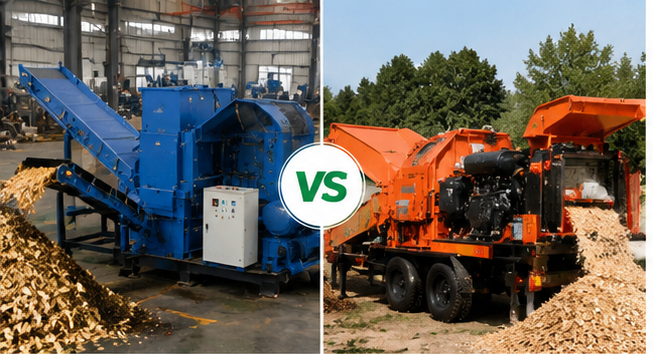
Electric Wood Crusher: Strengths and Limitations
Advantages of Electric Wood Crushers
Lower Operating Cost
Electricity is usually less expensive than diesel fuel in industrial environments.
For facilities processing large volumes daily, savings become significant over time.
For example: a 132kW electric wood crusher running 10 hours per day may consume electricity costing substantially less than an equivalent diesel engine consuming fuel throughout the same production period. Many pellet plants recover the price difference within the first year.
Reduced Maintenance Requirements
Electric motors contain fewer wear components.
There is no need for:
- Fuel filters
- Engine oil replacement
- Injector maintenance
- Cooling system servicing
This reduces downtime and maintenance labor.
Lower Noise Levels
Many municipal waste facilities and recycling centers face strict noise regulations. Electric units generally operate more quietly than diesel-powered machines.
This advantage becomes valuable in urban or semi-urban locations.
Better for Continuous Production
Pellet plants and biomass processing facilities often operate continuously. Electric crushers maintain stable speed and power output, supporting consistent particle size and production flow.
Limitations of Electric Wood Crushers
Dependence on Power Infrastructure
Without adequate electrical supply, operation becomes impossible. This is the most common issue encountered during project planning.
Chinese manufacturers frequently receive inquiries from customers who discover too late that their local transformer capacity cannot support large industrial motors.
Voltage Compatibility Concerns
Export projects require confirmation of:
380V / 400V /415V / 440V / 460V / 480V
as well as frequency:
50Hz / 60Hz
Motor configuration mistakes can delay commissioning and create unexpected costs.
This is why voltage confirmation is part of every project evaluation before production begins.
Diesel Wood Crusher: Strengths and Limitations
Advantages of Diesel Wood Crushers
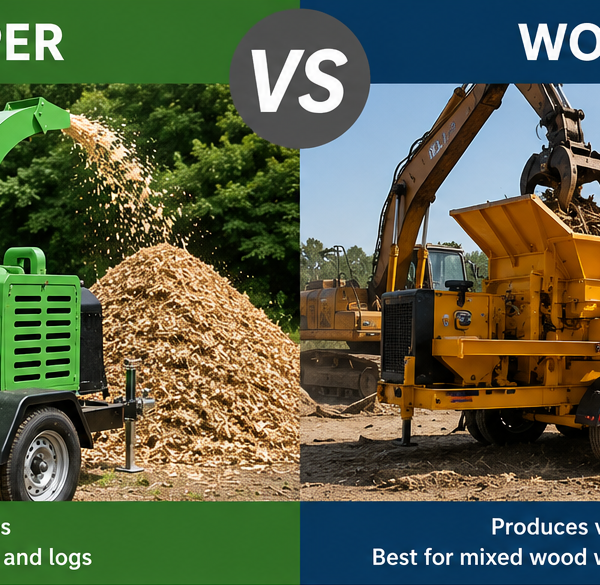
Excellent Mobility
This is where diesel-powered machines shine.
They can operate in:
- Forest sites
- Land clearing projects
- Mountain regions
- Remote agricultural areas
- No electrical infrastructure is required.
The machine can be transported directly to the material source.
Faster Project Deployment
Many contractors cannot wait months for utility installation. Diesel-powered units can begin work immediately after delivery.
This flexibility often outweighs higher operating costs.
Better for Temporary Operations
Projects involving:
- Storm cleanup
- Road construction
- Pipeline routes
- Forestry harvesting
- typically favor diesel-powered crushers.
The machine moves with the project.
Limitations of Diesel Wood Crushers
Higher Fuel Expenses
Fuel cost becomes substantial during long-term operation. A machine processing several tons per hour may consume a significant amount of diesel daily.
When annual production volume increases, fuel expenses often become the largest operating cost.
More Maintenance
Diesel engines require regular service:
- Oil changes
- Air filter replacement
- Fuel system maintenance
- Cooling system inspection
Neglecting maintenance increases breakdown risk.
Environmental Restrictions
Some regions continue tightening emission regulations. Government projects increasingly require equipment that complies with local environmental standards.
Buyers should verify regulatory requirements before purchasing.
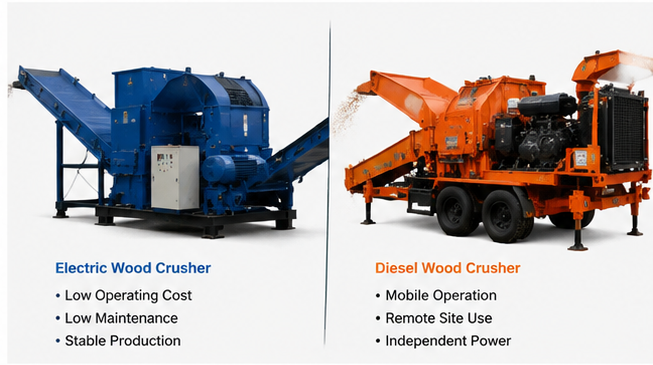
Side-by-Side Comparison
| Factor | Electric Wood Crusher | Diesel Wood Crusher |
| Mobility | Low | High |
| Fuel Cost | Low | High |
| Maintenance | Lower | Higher |
| Noise | Lower | Higher |
| Continuous Operation | Excellent | Good |
| Remote Work Sites | Limited | Excellent |
| Initial Infrastructure | Electrical System Required | Minimal |
| Environmental Impact | Lower | Higher |
Application Scenario #1: Biomass Pellet Production Plant
A biomass pellet plant in Southeast Asia processes:
- Wood chips
- Sawmill residues
- Branches
- Production runs 16 hours daily.
The facility already has industrial electrical infrastructure.
In this situation, an electric wood crusher typically delivers:
- Lower cost per ton
- Stable throughput
- Reduced maintenance downtime
- Most large pellet plants choose electric models for this reason.
Application Scenario #2: Land Clearing and Forestry Operations
A contractor in South America clears land for agricultural development.
Processing locations change weekly . Electrical supply is unavailable.
A diesel wood crusher allows:
- Immediate deployment
- On-site processing
- Reduced transportation of bulky waste
In this scenario, mobility generates greater value than fuel savings.
Hidden Procurement Risks Buyers Often Ignore
Risk 1: Oversized Capacity Selection
Many buyers request maximum capacity without evaluating actual material flow.
Oversized equipment increases:
- Capital cost
- Energy consumption
- Spare parts inventory
- Capacity should match realistic production targets.
Risk 2: Ignoring Spare Parts Availability
A crusher is only productive when replacement parts are accessible.
Before ordering, confirm availability of:
- Hammer blades
- Screens
- Bearings
- Belts
A lower machine price becomes irrelevant if spare parts take months to arrive.
Risk 3: Incorrect Voltage Configuration
This remains one of the most common export issues. Always confirm voltage specifications before manufacturing begins.
Export Delivery Experience from Chinese Manufacturers
After exporting wood crushing equipment to more than 40 countries, several delivery lessons consistently emerge.
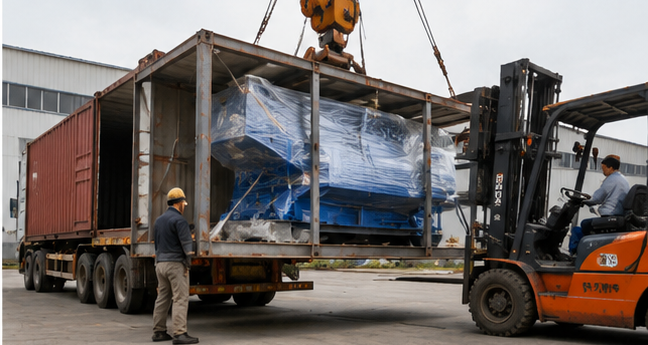
Steel Frame Packaging
Large crushers should be secured using reinforced steel-frame packaging. This reduces transportation damage during ocean freight.
Container Loading Verification
Photographs should document:
- Equipment fixation
- Spare parts placement
- Electrical cabinet protection
These records help resolve potential logistics disputes.
Documentation Accuracy
Buyers should verify:
- Packing list
- Commercial invoice
- User manual
- Electrical drawings
Before shipment departure. Small documentation errors often create larger delays than equipment manufacturing itself.
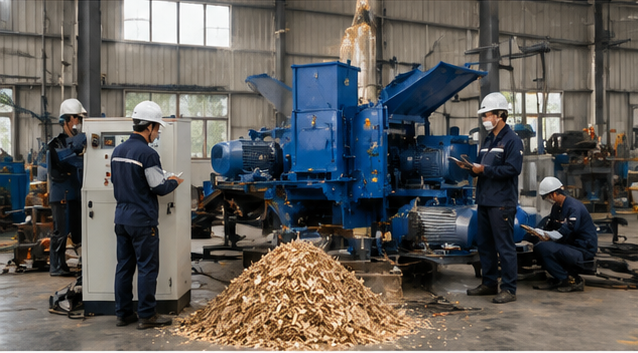
FAT Testing and Acceptance Before Shipment
Professional buyers increasingly request Factory Acceptance Testing (FAT).
Typical FAT procedures include:
1、No-Load Running Test
Verifies:
Motor rotation
Bearing temperature
Vibration levels
2、Loaded Material Test
Confirms:
Throughput
Output size
Stability
3、Electrical Inspection
Checks:
Control cabinet operation
Emergency stop functions
Protection systems
Video documentation is often provided for overseas customers unable to visit the factory.
Common Questions Overseas Buyers Ask
Which option is cheaper long term?
For fixed facilities operating daily, electric crushers usually provide lower total ownership cost.
Is diesel power stronger?
Not necessarily.
Machine design, rotor configuration, and feeding system often influence performance more than the power source.
Can electric machines be exported with IEC-compliant motors?
Yes. Most professional Chinese manufacturers can provide motors and electrical components that comply with IEC standards and local project requirements.
How long does delivery usually take?
Most standard configurations require approximately 20-45 days depending on capacity and customization requirements.
Which Type Should You Choose?
Choose an Electric Wood Crusher if:
- You operate from a fixed location
- Stable electricity is available
- Daily operating hours are high
- Long-term operating cost matters most
Choose a Diesel Wood Crusher if:
- Work locations change frequently
- Electricity is unavailable
- Mobility is critical
- Projects are temporary or remote
The best choice is rarely determined by machine price.
The best choice is the one that minimizes your processing cost per ton while matching your production environment.
FAQ
1、What capacity wood crusher is suitable for a pellet plant?
Most medium-sized pellet plants select equipment ranging from 5-20 tons per hour depending on feedstock type and production goals.
2、Can a diesel wood crusher be converted to electric later?
In some cases yes, but conversion costs can be substantial. Selecting the correct power system initially is usually more economical.
3、What should be included in spare parts packages?
Hammer blades, screens, bearings, belts, and essential electrical components are commonly recommended.
4、Is FAT testing necessary?
For export projects, FAT testing significantly reduces commissioning risks and helps verify equipment performance before shipment.
Call To Action
Planning to invest in a wood crusher for biomass fuel production, forestry waste recycling, or land clearing projects?
Send us your raw material type, target capacity, available power supply, and project location.
Our engineering team will recommend the most suitable electric or diesel wood crusher configuration, provide operating cost estimates, and arrange FAT testing before shipment to ensure smooth project implementation.